How do you get the best value for money in a professional insulated container ?
1 October 2026 by Edina GÁLFI
12 November 2026 by Edina GÁLFI

In the Netherlands, moving fresh food has long meant one thing : a refrigerated van. Yet a growing share of Dutch food logistics (online grocery rounds, foodservice deliveries, farm-to-door and meal-box flows, last-mile runs into city centres) works on a different principle: the insulated container paired with a passive cold source. No refrigeration unit, no fuel burned to make cold, no noise, no battery drain, and chilled food held below the legal 7 °C limit from loading dock to doorstep, in a completely standard vehicle. Manufacturing insulated containers since 1956, Olivo explains how passive cooling works, what it makes possible in Dutch conditions, where its limits lie, and how to choose the right equipment for your flows.
The principle rests on a pair of equipment. The insulated container first: its insulating walls drastically slow heat exchange between inside and outside. The passive cold source second: the eutectic plate, an accumulator filled with a fluid that freezes at a precise temperature. Recharged in a cold room or freezer before departure, it releases its cold steadily throughout the round, consuming nothing in transit, making no noise and needing no power connection.
The plate’s freezing point is matched to the product: a chilled-food formulation holds produce, dairy or meal boxes safely below 7 °C without freezing them, while a negative formulation keeps frozen goods at -18 °C or below. Properly sized, the container-plus-plates system covers typical Dutch delivery rounds from the cold store to the last drop, including the wait between drops.
The framework is EU food hygiene law applied through the Dutch Commodities Act (Warenwet) and the sector hygiene codes (Hygiënecode), enforced by the NVWA. The temperature rules are clear: chilled products must be kept at 7 °C or below during transport, unless the label specifies a lower temperature; frozen products at -18 °C or below; and hot food at 60 °C or above. Cooked dishes intended for chilled delivery must be brought down to 7 °C within five hours of preparation, and temperature checks must be recorded as part of your HACCP-based procedures.
Every stage of the journey must therefore be covered by equipment whose performance is known and demonstrable, with records to show at inspection. For international flows, a major reality for Dutch food exporters, the ATP agreement on the carriage of perishable foodstuffs sets the recognised standard: insulated containers tested and certified under ATP carry laboratory-measured proof of performance that customers and auditors accept without discussion.

To support this reflection, a benchmark study offers a comparative analysis of insulated container technologies, based on logistics use cases and field constraints.

The case for passive cooling goes well beyond the purchase price of the vehicle.
Passive cooling is not universal, and a serious manufacturer says so plainly. Its autonomy, several hours, is sized on the real duration of the round: for very long hauls without recharging options, or operations that keep doors open all day, the refrigerated vehicle keeps its place. The system also demands operational discipline: plates fully charged before every departure, several sets rotating so one recharges while another is on the road, short door openings, seals in good condition. These constraints are light against the gains, but they must be built into the operation from day one. That is precisely what a proper sizing study validates: that autonomy covers your circuit, with a safety margin, on your most demanding round.
INFORMATIONS
Are you hesitating between several insulated container solutions ?
Talk to an Olivo expert to analyze your current use and operational issues.

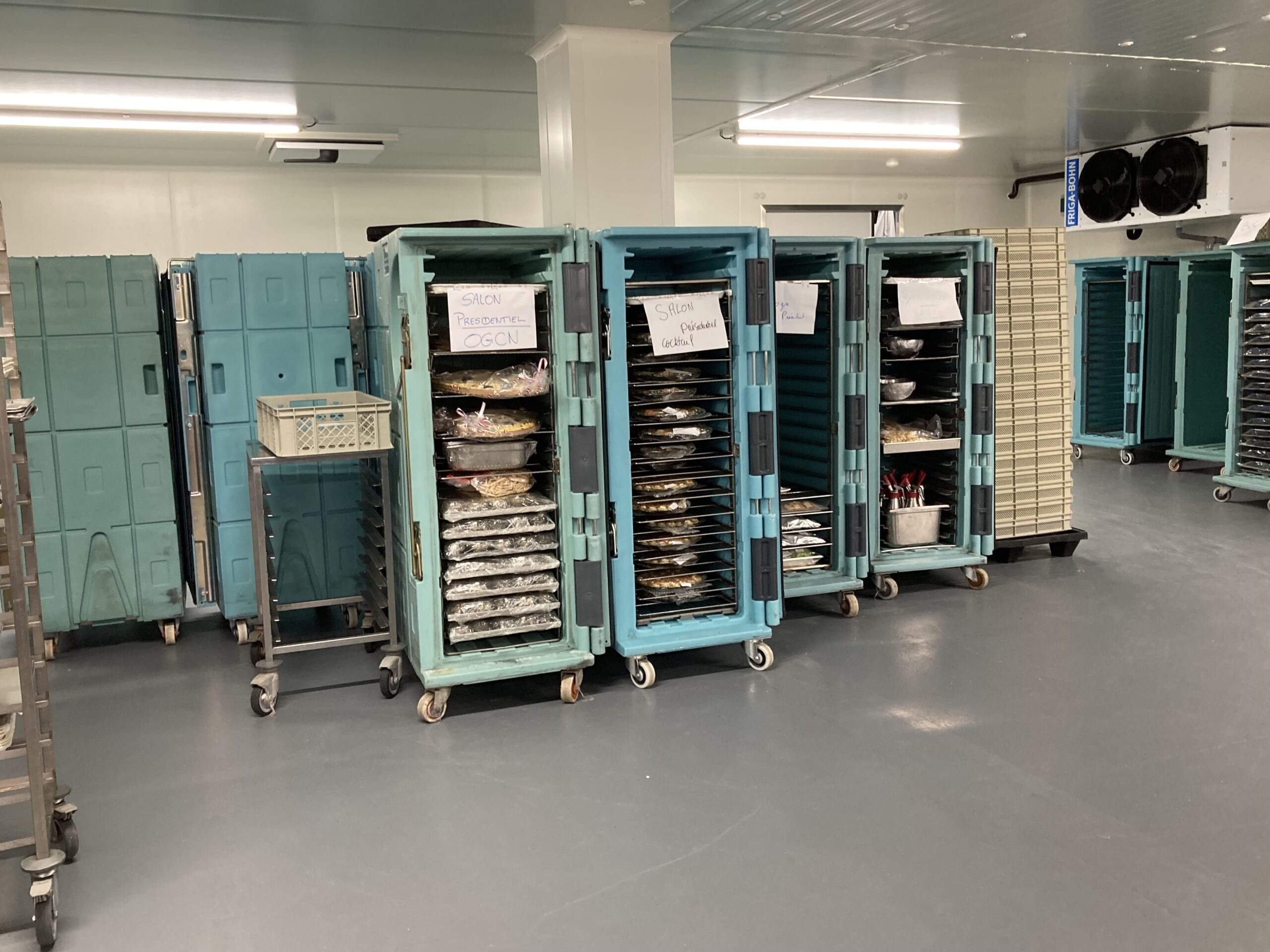
For distribution rounds with substantial volumes per drop (supermarkets, foodservice, institutional kitchens), a roll container such as the insulated ROLL loads at the warehouse, rolls into the vehicle and on to the point of delivery, with no carrying and no break in the cold chain.
For fractioned flows (online grocery orders, meal boxes, farm shops shipping direct, several customers on one round), the compact, stackable insulated BAC assigns one container per order or product family, labelled and at its own temperature, in a small van or on a cargo bike.
For long legs between sites or consolidated flows towards a hub, the rigid, large-volume insulated BOX with reinforced insulation provides the thermal autonomy that long-duration transport demands, in warm weather included.
All three formats take the same eutectic plates and combine in one vehicle: that is how multi-customer, multi-temperature rounds run on a completely standard fleet.
Real performance depends on a few parameters set with method. The total duration of the circuit first, from loading to the last drop, delays included: it determines the autonomy required. The plates’ freezing point next, matched to each product family. The number of plate sets finally: to run daily rounds, one set recharges while another is on the road, and your cold room or freezer capacity must keep pace. Add the operating rules that preserve the cold reserve (loading in reverse delivery order, short door openings, temperature records at critical points) and the system becomes robust to real-world conditions. An experienced manufacturer sizes all of this with you from your actual rounds, not from theoretical tables.
Several hours, depending on the insulation quality, the number and type of eutectic plates, the outside temperature and how often doors are opened. Typical Dutch delivery rounds are comfortably covered. Good practice is to size the system on your most demanding round, with a safety margin, which is what a tailored assessment provides.
Yes, provided the equipment keeps the product within the legal limits for the whole journey: 7 °C or below for chilled goods, -18 °C or below for frozen. What the NVWA and your customers look at is the result and the records, not the technology. Insulated containers with properly charged eutectic plates deliver both, and ATP-certified equipment adds laboratory-measured proof of performance.
It is one of its best applications: unlike a refrigeration unit, insulated containers and eutectic plates draw nothing from the vehicle’s battery. Range is preserved, deliveries stay silent, and compact formats ride on cargo bikes, which makes passive cooling the natural fit for zero-emission zones in Dutch city centres.
Yes. Each container holds its own temperature range with its own plates, so chilled, frozen and ambient goods combine in one standard vehicle without refrigerated bulkheads. This consolidation cuts the number of rounds and the cost per drop.
Transporting fresh food without a refrigerated van is neither a workaround nor a gamble: it is an approach proven at scale, more sober, more reliable and often more economical than all-refrigerated fleets, provided the system is sized on real flows. Since 1956, Olivo has designed and manufactured in France the professional insulated containers and eutectic plates that make this logistics possible, supporting each customer from the sizing study to the end of the equipment’s life. Want to know what passive cooling could cover in your operation? Contact our teams: we study your rounds with you and answer with figures.
Do you need more information or would you like to talk to our teams about your project ?

ZA Charles Chana
1 boulevard des Mineurs – CS 50019
42230 Roche-la-Molière

Tel : +33 (0)4 77 90 68 63
1 October 2026 by Edina GÁLFI
12 November 2026 by Edina GÁLFI
29 October 2026 by Edina GÁLFI