

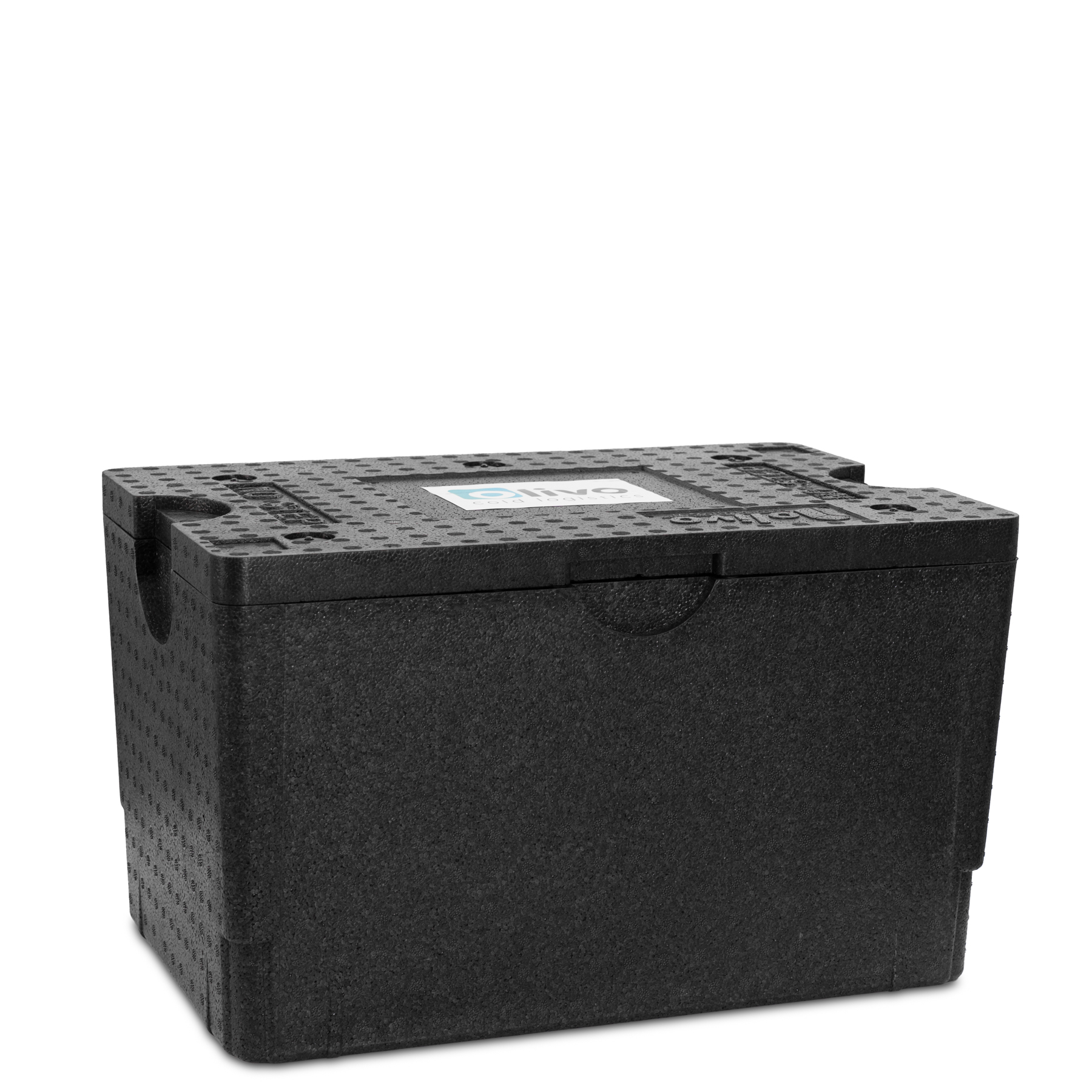
Ext. dim. : 555 x 360 x 331 mm,
Volume : 34 L,
Cold sources : eutectic plate TOP 64 et SiberCity®,
View detailsIn autonomous cold chain logistics, with no onboard refrigeration unit, everything hinges on a single element: the cooling source. It is what maintains the target temperature throughout the entire delivery round, in a standard vehicle. Yet this choice is often inherited from an old set of specifications and rarely reconsidered. Poor sizing can cost you an entire round: destroyed goods, penalties, documented HACCP non-compliance, several tens of thousands of euros for a single temperature excursion. Since 1956, we have been designing two complementary technologies (the eutectic plate and the SIBER SYSTEM®) to cover the full range of temperature-controlled distribution needs. This comparison gives you the keys to choosing, or combining, the right solution.
Photo credit @CélineVautey

Three sets of standards govern the transport of temperature-sensitive products in Europe. They do not mandate a specific technology, but rather precise performance levels that your cooling source must guarantee.
Regulatory standards and their implications
| Standard | Scope | Implication for the cooling source |
|---|---|---|
| ATP | International carriage of perishable foodstuffs; certification of transport equipment is mandatory in certain European countries. | The equipment must maintain the reference temperature for the full duration of the test. |
| HACCP | Food safety; hazard analysis and critical control points. | Temperature is a critical control point (CCP): any deviation must be recorded and justified. |
| GDP | Transport of medicines and pharmaceutical products (guidelines 2013/C 343/01). | Documented thermal validation is mandatory; full temperature traceability required. |
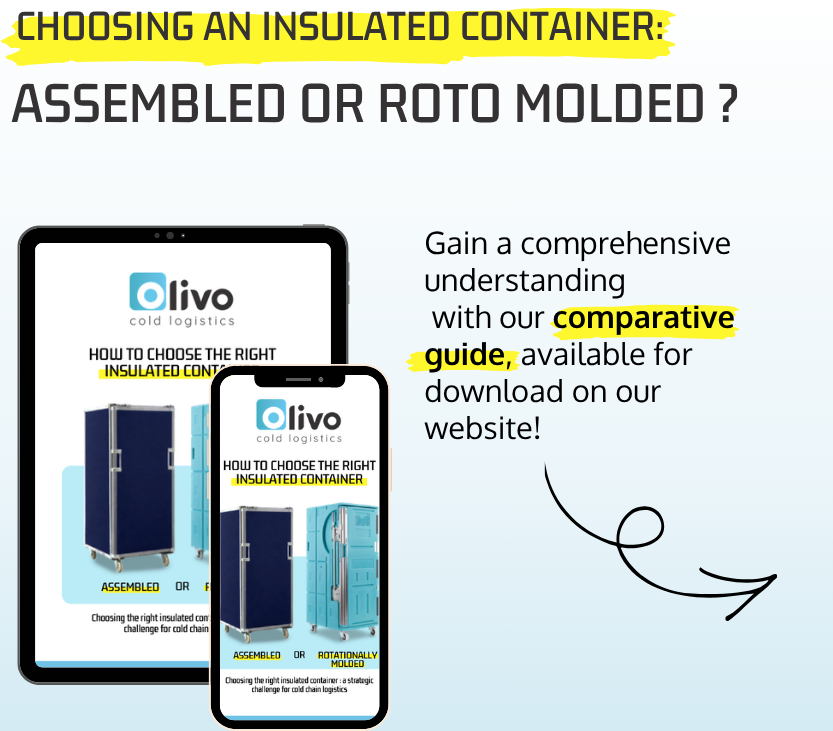
To support this reflection, a benchmark study offers a comparative analysis of insulated container technologies, based on logistics use cases and field constraints.
The eutectic plate is a passive cold accumulator. Its principle rests on the latent heat of phase change: when a substance moves from solid to liquid, it absorbs a large quantity of thermal energy without any variation in temperature. This is the mechanism that maintains thermal stability inside the container. The Olivo eutectic solution, formulated in-house, has a precisely defined melting point — the eutectic point — calibrated for each target temperature.
It works in three simple, repeatable stages: charging (the plate solidifies for a minimum of 24 hours in a chamber set at least 5 °C below the eutectic point), transport (placed inside the insulated container, its gradual melting maintains the target temperature), and return (fully liquid, it goes back into the chamber for a new cycle, with no degradation).
Olivo has developed 7 distinct eutectic liquids covering −26 °C to +21 °C, the most versatile coverage on the market for a single-temperature range.
| Eutectic point | Application | Sector |
|---|---|---|
| −26 °C | Deep-frozen goods | Food, contract catering |
| −21 °C | Frozen products | Food, grocery retail logistics |
| −17 °C | Semi-frozen products | Catering, artisan ice cream |
| −12 °C | Semi-frozen products | Catering, artisan ice cream |
| −3 °C | Fresh produce, meat, fish | Food, healthcare |
| 0 °C | Medicines, vaccines, plasma | Healthcare |
| +21 °C | Fruit and vegetables, ambient products, healthcare | Food, healthcare |
A plate stock to manage: storage, cleaning and traceability all require dedicated organisation.
One temperature per plate: delivering chilled and frozen goods on the same round means two separate sets of plates.
Planning is essential: charging must begin at least 24 hours in advance. A forgotten batch or a cold room breakdown can derail the round.
Ext. dim. : 555 x 360 x 331 mm,
Volume : 34 L,
Cold sources : eutectic plate TOP 64 et SiberCity®,
View details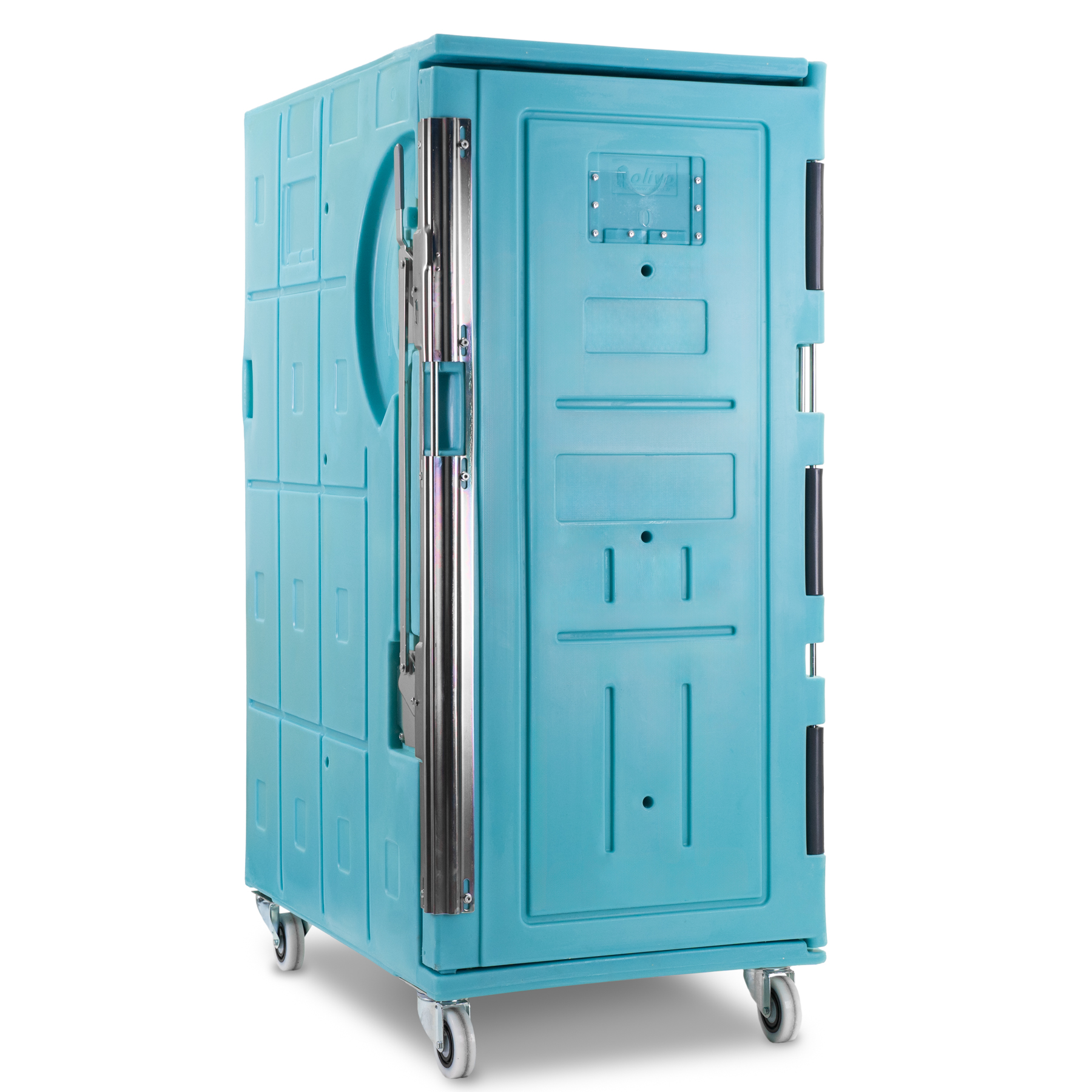

Ext. dim. : 800 x 1200 x 1860 mm,
Volume : 885 L,
Cold sources : eutectic plate TOP 900 et SiberSnow ®,
Logistics format : Euro-pallet 800 x 1200
View detailsWhat if your cooling source were ready in a matter of seconds, with no need to plan the day before and no plates to handle? That is the promise of the SIBER SYSTEM®, a patented cryogenic technology co-developed by Olivo and Messer, a global specialist in industrial gases. It works by controlled injection of LCO2 (liquid carbon dioxide) which, as it expands, turns into dry ice snow and then sublimates directly from solid to gas at −78.5 °C.
In seconds, the injection station fills the SIBER bin with dry ice snow and the container is ready to go. Worth noting: 2.2 kg of LCO2 produces 1 kg of dry ice snow, delivering 2 to 3 times the cooling capacity of an equivalent volume of eutectic plates.
INFORMATIONS
Are you hesitating between several insulated container solutions ?
Talk to an Olivo expert to analyze your current use and operational issues.
Full comparison: eutectic plate vs SIBER SYSTEM®
| Criterion | Eutectic plate | SIBER SYSTEM® |
|---|---|---|
| Principle | Latent heat of fusion (solid → liquid) | Sublimation, change of state (solid → gas) |
| Preparation | 24 to 48 hours charging in a refrigerated chamber | Injection in seconds, just before departure |
| Autonomy | 12 to 24 hours (depending on logistics conditions) | More than 24 hours (depending on LCO2 dose) |
| Target temperatures | −26 °C to +21 °C (7 formulations) | Both chilled and frozen ranges |
| Multi-temperature | No: one plate = one temperature | Yes: chilled and frozen in the same SIBER bin |
| Cooling capacity | Up to 275 kJ/kg | Up to 580 kJ/kg (2 to 3× a plate) |
| Consumable | None | LCO2 (liquid carbon dioxide) |
| Infrastructure | Freezer set below the plates’ melting point | LCO2 injection station + Messer bulk storage tank |
| Investment | Container + sets of plates + rack + refrigerated chamber | Container + SIBER bin + injection totem + LCO2 tank |
| Recurring cost | Energy for the freezing chamber | LCO2 + energy for the totem |
| Training | Plate freezing protocol | CO2 safety procedures |
| Handling | Plates to load and unload | No cooling source to manage |
| Regulations | HACCP, ATP, GDP | ADR, HACCP, ATP, GDP |
| Residue after use | None | None (the dry ice sublimates completely) |
| Environmental profile | Non-toxic solution, recyclable EPP casing | CO2 recovered from industrial food-sector reprocessing |
| Scale of operation | Up to 200 km / multi-stop round | Beyond 200 km / multi-stop round |
| Ideal for | Rounds under 12 hours, single-temperature, simplicity | Long distances, multi-temperature, high volumes (from 80 roll cages per day) |
The eutectic plate is your solution if:
The SIBER SYSTEM® is your solution if:
A useful benchmark: the eutectic plate excels on short-haul routes (under 200 km, multi-stop); the SIBER SYSTEM® takes over beyond that, on long distances and multi-temperature work. One caveat: some fresh products deteriorate on contact with a cryogenic solution, a point to confirm with our teams.
Comparing two cooling sources on purchase price alone leads to expensive decisions. The analysis needs to take in the cost of ownership (service life, depreciation), infrastructure costs (chamber, CO2 station, training), recurring operating costs (energy, consumables, maintenance), avoided costs (breakdowns, penalties, product losses, labour) and productivity gains (combining rounds). On that basis, the eutectic plate draws its strength from having no consumable; the SIBER SYSTEM® from its ROI on large operations and from combining chilled and frozen loads.
Whichever solution you choose, the final decision is only reliable once a thermal assessment has been carried out: the calculation of exactly how much cooling energy is needed under your real-world conditions. It takes in the outside temperature, the container’s insulation coefficient (W/m².K, ATP-certified equipment), the exchange surface area, the duration of the round, the initial thermal load of the products and door openings.
The heat flow formula, Q (W) = K × S × ΔT, determines the number of plates required or the quantity of LCO2 to inject. Sizing based on a “typical” round, without factoring in extreme cases such as heatwaves or delays, is a direct cause of cold chain failure: always allow a safety margin of 10 to 20%.
It depends on your rounds. The eutectic plate suits short-haul routes (under 12 hours), single-temperature operations and the lowest total cost over 10 years. The SIBER SYSTEM® comes into its own on long distances, multi-temperature work and high volumes, with cooling ready in seconds. The two can also work side by side.
It is a passive cooling source that releases the cooling energy stored during freezing. The eutectic plate is its professional form: its solution has a calibrated melting point (the eutectic point) which holds a constant temperature throughout the melting phase.
The eutectic plate provides 12 to 24 hours depending on conditions and the number of plates carried. The SIBER SYSTEM® exceeds 24 hours, with autonomy adjusted according to the LCO2 dose.
The eutectic plate works by fusion (passive, reusable cooling, leaving no residue). Dry ice, the dry ice snow used by the SIBER SYSTEM®, works by sublimation at −78.5 °C: very high cooling capacity and cooling on demand, but it is a consumable and falls under ADR regulations.
It withstands several thousand cycles, with a service life commonly exceeding 6 to 10 years, and no recurring consumables.
Yes. Both allow HACCP- and GDP-compliant traceability and fall within the ATP framework; the SIBER SYSTEM® additionally comes under the ADR regulations governing CO2. We recommend fitting a data logger to the container for continuous recording.
Through a thermal assessment (Q = K × S × ΔT) that factors in your real-world conditions and a safety margin of 10 to 20%. Our experts carry it out with you.
The question “eutectic plate or SIBER SYSTEM®?” has no single answer. It calls for an analysis of your operational, regulatory and economic situation. For 70 years, we have been putting that expertise at your disposal to examine your flows, your day-to-day constraints and your objectives, and to guide you towards the cooling source best suited to how you actually work.
1 October 2026 by Edina GÁLFI
17 September 2026 by Edina GÁLFI
3 September 2026 by Edina GÁLFI