

Which insulated container should you choose for school meals delivery ?
17 September 2026 by Edina GÁLFI
17 September 2026 by Edina GÁLFI
Every school day, thousands of meals leave central production kitchens across the UK and travel to school serveries and dining halls, where they must arrive at the right temperature for a single, tightly timed lunch service. With the expansion of free school meal provision pushing volumes up, the link between the production kitchen and the school gate has never carried so much responsibility: food safety for some of the most vulnerable diners, compliance with temperature law, and the day-to-day workload of catering teams. Drawing on 70 years alongside food service professionals, Olivo looks at what makes school catering logistics unique, what UK regulations require, and how to choose insulated containers that hold up to the daily round.
Delivering school meals is unlike any other food service operation. The entire output of a central production kitchen converges on one service window, lunchtime: every school on the round must be delivered during a short morning slot, with regeneration or service following straight after. A single kitchen often supplies dozens of sites of very different sizes, from large secondaries with proper goods access to small primaries where deliveries come through a side door and a narrow corridor.
Four operational realities shape the equipment choice:
The framework is food hygiene law built on HACCP principles, enforced by local authority environmental health officers with guidance from the Food Standards Agency. The temperature rules are precise. Hot food must be held at 63 °C or above until service. Chilled food must be kept at 8 °C or below, the legal maximum in England, Wales and Northern Ireland, with 5 °C or below widely applied as best practice. In cook-chill systems, established guidance calls for chilling to between 0 and 3 °C shortly after cooking and holding that range through storage and distribution. Scotland adds its own requirement: food reheated for service must reach 82 °C.
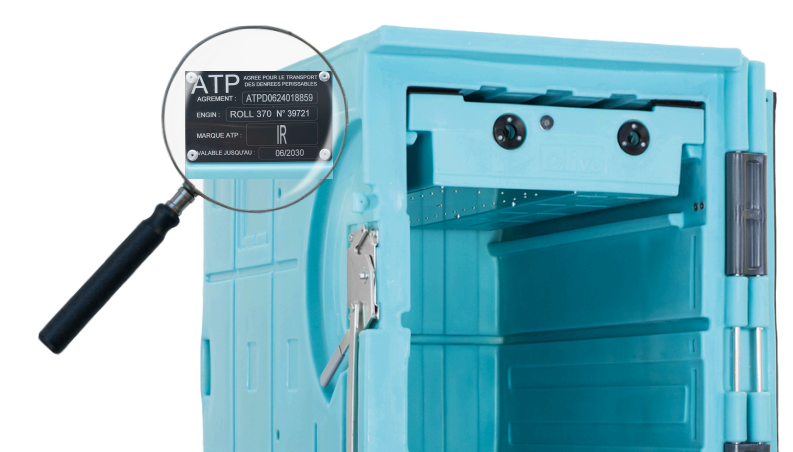
In practice, this means every stage of the journey (loading, transport, waiting at the school, regeneration or service) must be covered by equipment whose thermal performance is known and demonstrable. Temperature records at dispatch and at each delivery point are part of the food safety management system, and they are the first thing an inspector asks for after an incident. For the transport equipment itself, the ATP agreement on the carriage of perishable foodstuffs provides the recognised performance benchmark: containers tested and certified to ATP standards give caterers evidence, not assurances.
To support this reflection, a benchmark study offers a comparative analysis of insulated container technologies, based on logistics use cases and field constraints.

The container must hold the target temperature from loading at the production kitchen to the last school served, including the wait before regeneration. The sizing point is the final delivery of the round, not the first. Paired with eutectic plates at the right freezing point, a passive insulated container holds chilled food within range for hours, in a standard van, with no refrigeration unit, including in warm weather at the end of the summer term.
School catering runs on gastronorm pans (GN 1/1, GN 2/1) and sealed trays. Containers should take these formats without excessive play, to optimise loading and avoid the thermal bridges of a half-empty box, while remaining compatible with real school access: door widths, steps, no loading bay.
Low empty weight, quality castors that reduce the push-pull effort, simple door catches, handles at working height: every ergonomic detail counts for staff who move containers every day. This is a compliance issue as much as a comfort one, since reducing manual handling risk is a legal duty, and it directly affects sickness absence in catering teams. Easy cleaning and disinfection, with the means available in a school servery, completes the requirement.
A school meals container works every term-time day, gets washed after every service and sits in storage over the holidays. Industrial-grade equipment lasts well beyond six years of intensive use, as Milutin Savkovic, supply chain support at Delhaize Serbia, confirms: “The product is good. The lifespan of the product goes beyond 6 years. The eutectic plates are also efficient and robust.” Over the life of a catering contract, that longevity transforms the whole-life cost calculation.
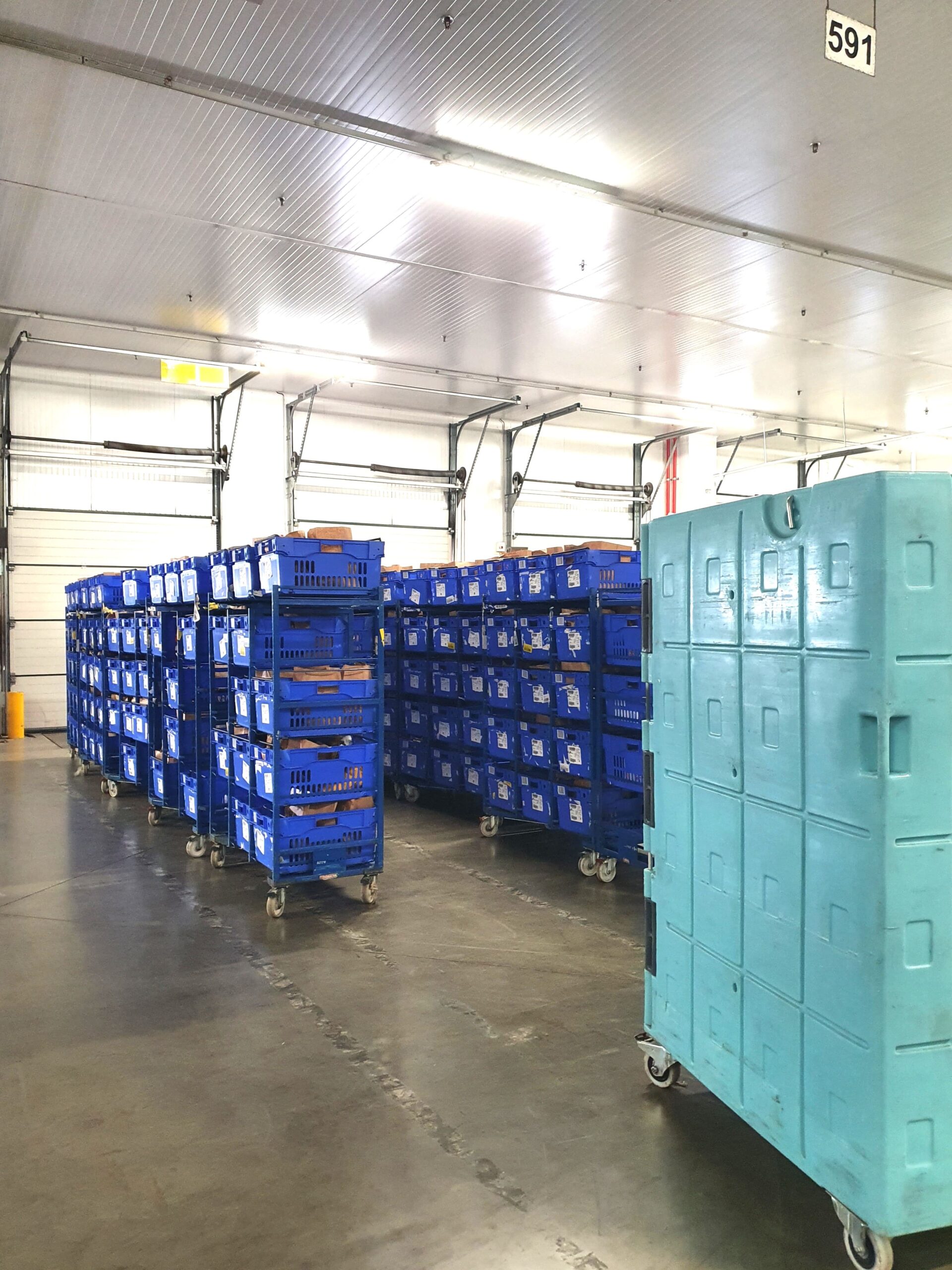
This is the classic model: a central production kitchen supplying a round of schools each morning. A roll container such as the insulated ROLL loads gastronorm pans on several levels, is organised school by school inside the vehicle, and rolls from van to servery with no carrying: stops are shorter, delivery errors drop, and the round fits the morning window.
For small primaries, serveries without wheeled access, or the strict segregation of allergen-safe and special diet meals, the logic is fractioning: a compact, stackable insulated BAC, labelled by school, by class or by diet, travels in the same vehicle as the rolls and guarantees that no sensitive meal mixes with the rest.
Where a production kitchen serves a wide catchment, or a multi-academy trust consolidates meals towards a hub before local distribution, the journey demands extended thermal autonomy: a rigid insulated BOX secures the long leg before meals are broken down into local rounds.
Most operations end up combining formats. What matters is that the whole fleet shares the same eutectic plates and the same cleaning protocols, so serveries do not multiply procedures.
INFORMATIONS
Are you hesitating between several insulated container solutions ?
Talk to an Olivo expert to analyze your current use and operational issues.

An insulated container does not produce cold: it slows heat exchange. Active temperature holding comes from the eutectic plate, a cold accumulator recharged in a cold room or freezer before departure, which releases its energy steadily throughout the round without consuming anything in transit. Two parameters deserve care: the plate’s freezing point, matched to the food carried (a frozen-food formulation can freeze chilled dishes), and the number of plate sets, so one set recharges while another is on the road. For hot transport, insulation is complemented by a heat source such as a heating plate, an item available from specialist equipment suppliers.
Operational discipline does the rest: load in reverse delivery order so each stop only exposes that school’s meals, keep door openings short, record temperatures at every delivery point, and use the school holidays for preventive maintenance, checking seals and castors so term starts with equipment performing as new.
For a local authority catering service or a contract caterer, insulated containers are also a tender argument. Reasoning in whole-life cost over the contract term (real lifespan, availability of wear parts, maintenance, periodic ATP renewal) protects margins against the illusion of the lowest unit price. And the sustainability criteria that public procurement increasingly rewards find a concrete answer here: durable, repairable, recyclable equipment, passive cooling with no energy consumption in transit, and consolidated multi-temperature flows that cut vehicle rotations and emissions. Passive cold is also the natural partner of electric delivery vans, since it draws nothing from the battery.
Both models are compliant and both are common in the UK. Cook-chill offers production flexibility and safety margins on longer rounds: meals travel chilled and are regenerated on site. Hot transport, with food held at 63 °C or above until service, suits short circuits with tight timings. In both cases, the insulated container is what guarantees the temperature during transport and the wait before service.
Several hours, depending on the quality of the insulation, the number and type of eutectic plates, the outside temperature and how often doors are opened. Typical school rounds are comfortably covered. Good practice is to size the system on your most demanding round, with a safety margin, which is what a tailored assessment provides.
Not necessarily. An insulated container with properly charged eutectic plates holds chilled food within legal limits in a standard van, with no refrigeration unit. This cuts running costs, removes a failure point, keeps deliveries quiet and works particularly well with electric vehicles, since nothing draws on the battery.
Separately, clearly labelled, and at the regulated temperature. Dedicated small-format insulated containers, labelled by school and by diet, remove the risk of confusion or cross-contact between the production kitchen and the servery, and make checks quicker for the catering team at the point of service.
Choosing the right insulated containers for school meals means guaranteeing safe food for sensitive diners every lunchtime, hitting a tight morning delivery window, and giving catering teams equipment that does not wear them down. Since 1956, Olivo has designed and manufactured professional insulated containers in France, supporting caterers throughout the life of the equipment, from sizing to end-of-life recycling. Want to identify the right solution for your school rounds? Contact our teams: we study your delivery model with you and recommend exactly the equipment you need.
Do you need more information or would you like to talk to our teams about your project ?

ZA Charles Chana
1 boulevard des Mineurs – CS 50019
42230 Roche-la-Molière

Tel : +33 (0)4 77 90 68 63
17 September 2026 by Edina GÁLFI
3 September 2026 by Edina GÁLFI
2 July 2026 by Edina GÁLFI