

How do you get the best value for money in a professional insulated container ?
1 October 2026 by Edina GÁLFI
1 October 2026 by Edina GÁLFI
How much should a good insulated container cost, and which one offers the best value for money ? Every caterer, food distributor or logistics manager equipping or renewing a fleet asks the question. But it is usually asked the wrong way round: for equipment used daily for years, the purchase price is a misleading indicator. The real measure is the cost per year of service, once you count the actual lifespan, the maintenance, the spare parts and what a failure costs you. A French manufacturer of insulated containers since 1956, Olivo breaks down what drives the price of professional equipment, the hidden costs of budget kit, and the method for comparing quotes on a like-for-like basis.
Two containers that look alike can carry very different prices, and the difference almost always sits where you cannot see it at first glance.
The insulation first: the thickness and quality of the insulating foam, continuity without thermal bridges, the tightness of the seals and the design of the doors determine thermal performance and how well it holds over time. The structure next: professional equipment absorbs thousands of loading, washing and transport cycles, and resistance to impacts, detergents and UV is paid for at manufacture and repaid in service. The hardware too: castors, catches, hinges and handles are the first failure points on cheap kit. Certification finally: thermal testing and ATP certification, which give inspectors and customers measured proof of performance, represent an investment that budget equipment rarely makes.
On top of these come the elements that are a matter of choice: customisation (dimensions, runners, accessible braking, identification) and the level of manufacturer support, from sizing to maintenance. A price never reads alone: it reads against what it contains.
The arithmetic looks simple at purchase: why pay more for an apparently equivalent service? Because the costs of budget equipment arrive after the invoice.
The first is replacement: entry-level kit that degrades in two or three years gets bought two or three times over the lifespan of professional equipment, which exceeds six years of intensive use. Milutin Savkovic, supply chain support at Delhaize Serbia, confirms it from long experience: “The product is good. The lifespan of the product goes beyond 6 years. The eutectic plates are also efficient and robust.”
The next costs are more insidious. Insulation that ages badly means thermal performance drifting with no visible sign, up to the non-compliance recorded at inspection or, worse, a lost load. Poor castors and handles mean daily strain for your staff, with the manual handling duty and sickness absence that follow. And unavailable spare parts mean replacing a whole container for the sake of a tired seal. Each of these lines, invisible on the initial quote, weighs more on real cost than the price gap at purchase ever did.
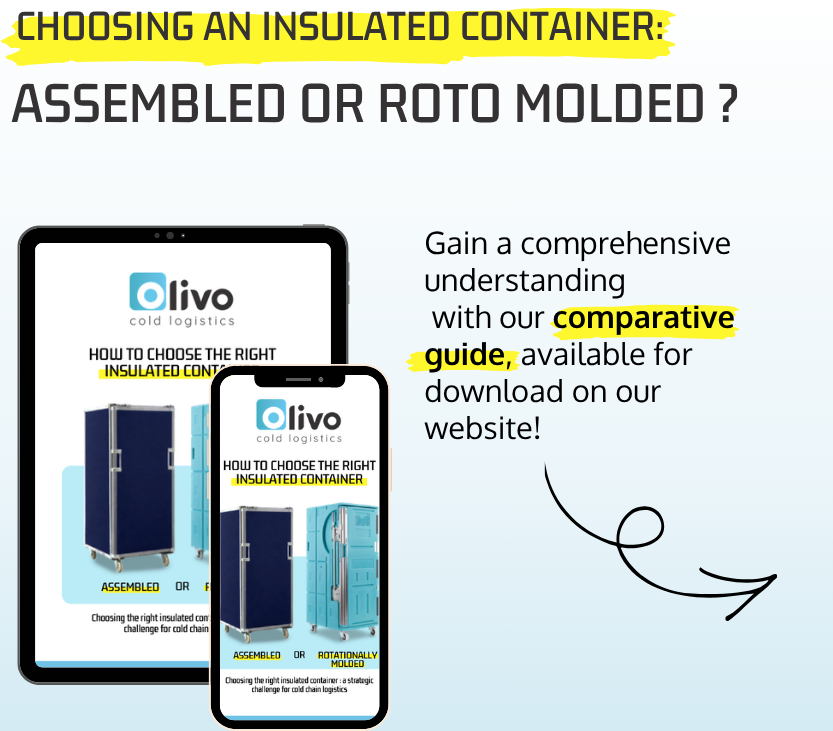
To support this reflection, a benchmark study offers a comparative analysis of insulated container technologies, based on logistics use cases and field constraints.

Value for money is measured with one simple indicator: whole-life cost per year of service. On top, everything the equipment costs across its life: purchase price, servicing and wear parts, periodic ATP renewal, minus its end-of-life value. Underneath, its real lifespan. A container that costs twice as much but lasts three times as long, with fewer incidents, wins the comparison without discussion.
In that equation, repairability is the most powerful lever: seals, castors, doors and catches are wear parts, and replacing them restores the container’s original performance for a fraction of the price of new. A manufacturer that services and repairs its own equipment, commits to spare parts availability and supports periodic ATP renewal mechanically transforms the value for money of its product.
Right-sizing matters just as much: the correct format is the first source of savings. A compact insulated BAC well chosen for fractioned flows will serve better than an oversized container travelling half empty, which costs more to buy and performs worse thermally. Conversely, a high-volume round gains from an insulated ROLL, which saves handling time at every stop, and a long leg from an insulated BOX, whose reinforced insulation avoids paying for a refrigerated vehicle. Customisation is not a luxury: it is what stops you paying for capacity you do not need, or under-specifying what is critical.
The second-hand catering equipment market is well established in the UK, and the appeal is understandable: lower initial outlay, and well-built professional containers hold their value. But the trade-off demands rigour, because the main risk of used equipment is invisible: insulating foams age, and a container that has lost part of its thermal performance shows nothing on the outside. Before buying used, three checks are essential: the year of manufacture and a documented service history, the validity of certifications (including ATP where required, issued for a limited period and renewed after testing), and the condition of the wear parts. A service before commissioning (seals, castors, catches) is the indispensable complement.
Second-hand makes most sense for a first-time user validating a need before investing. For a fleet working daily, new professional equipment, with its full lifespan, certified performance and manufacturer support, almost always delivers the better cost per year of service.
INFORMATIONS
Are you hesitating between several insulated container solutions ?
Talk to an Olivo expert to analyze your current use and operational issues.

One last reflex to make value for money objective: check that the offers you compare cover the same thing. A “container only” quote and a “complete system” quote are not comparable. Check what is included in cold sources (eutectic plates, in sufficient sets for rotation), in trade-specific adaptations, in sizing support, in spare parts commitments and in life-cycle services. Ask systematically for the thermal test reports: at equal price, measured performance decides; at equal performance, the service content makes the difference. Set these elements side by side and “best value for money” stops being a slogan and becomes a calculation.
Prices vary widely with volume, insulation performance, certification, options and quantities: professional equipment is sold on quotation, sized on actual needs. The relevant indicator is not the unit price but the whole-life cost per year of service, which factors in lifespan (beyond six years for industrial-grade equipment), servicing and end-of-life value. When buying, always compare quotes on a like-for-like scope, cold sources and services included.
Usually yes, as soon as use is daily: early replacement, drifting thermal performance, unobtainable parts and daily strain on staff end up costing more than the initial price gap. Budget kit can be defensible for very occasional use; for a professional fleet working every day, durability and repairability are the real levers of economy.
It can work, provided you demand full traceability: year of manufacture, documented service history, valid certification, condition of wear parts. The main risk is the invisible ageing of the insulation, which only testing reveals. A service before commissioning is essential. For intensive use, new professional equipment generally delivers a better cost per year of service.
Through regular care of the wear parts: checking and replacing seals (a tired seal sharply degrades insulation), castors and catches, cleaning to the manufacturer’s guidance, and preventive maintenance. Periodic ATP renewal validates that performance remains compliant. Well maintained, industrial-grade equipment comfortably exceeds its six-year benchmark of intensive use.
The best value for money in a professional insulated container is found neither on the lowest price tag nor on the highest: it is calculated, over the equipment’s real lifespan, counting what maintenance costs, what failures avoided are worth and the time your teams save. On that arithmetic, durability, repairability and right-sizing win almost every time. Since 1956, Olivo has designed and manufactured professional insulated containers in France, built to last, maintained throughout their life and recycled at the end, in a logic of partnership rather than volume. To put figures on your next investment, contact our teams: we study your flows and give you a complete-scope, sized quotation.
Do you need more information or would you like to talk to our teams about your project ?

ZA Charles Chana
1 boulevard des Mineurs – CS 50019
42230 Roche-la-Molière

Tel : +33 (0)4 77 90 68 63
1 October 2026 by Edina GÁLFI
17 September 2026 by Edina GÁLFI
3 September 2026 by Edina GÁLFI