

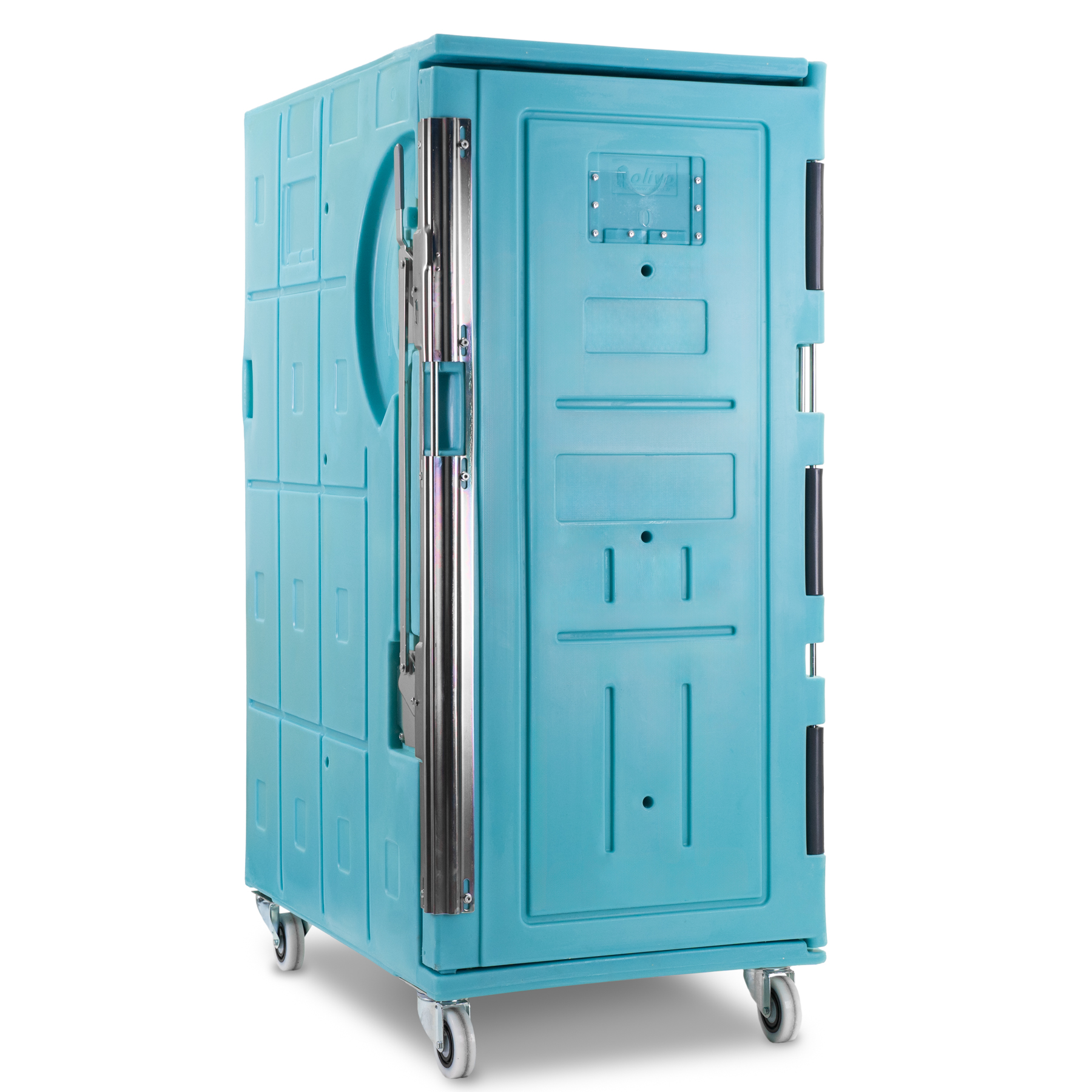

Ext. dim. : 800 x 1200 x 1860 mm,
Volume : 885 L,
Cold sources : eutectic plate TOP 900 et SiberSnow ®,
Logistics format : Euro-pallet 800 x 1200
View detailsChoosing an insulated container commits your cold chain for many years. Behind seemingly similar formats, two manufacturing technologies coexist: the assembled container, made of insulating panels joined together, and the rotomolded container, formed as a single piece.
We have been designing and manufacturing insulated containers in France since 1956; this comparison covers the criteria we use with our clients, thermal performance, hygiene, service life, total cost of ownership, to help you make an informed choice.

| Criterion | Assembled container | Rotomolded container (one-piece) |
|---|---|---|
| Design | Independent insulating panels joined by mechanical fasteners | One-piece polyethylene structure, integrated insulation with no assembly |
| Thermal performance | Thermal bridges at junction areas; performance depends on assembly quality | Uniform thermal resistance, with no geometric breaks or heat leakage |
| Durability over time | Micro-cracks, delamination, seal tearing, loss of flatness | Structural integrity preserved, even under intensive use |
| Hygiene | Seals, gaps and interfaces: areas where water and biofilms build up | Smooth, continuous, uniform walls; fast and consistent cleaning |
| Repairability | Panel replacement and spare parts; weakened junctions | Plastic welding: repair by adding material, no spare parts needed |
| Operational availability | More frequent downtime as equipment ages | Reduced downtime, continuity of service |
| End of life | Multiple materials, complex sorting streams | Uniform material: easier recycling, circular economy |
| Total cost of ownership (TCO) | Sometimes lower purchase price, growing recurring costs | Economic performance over the full service life |
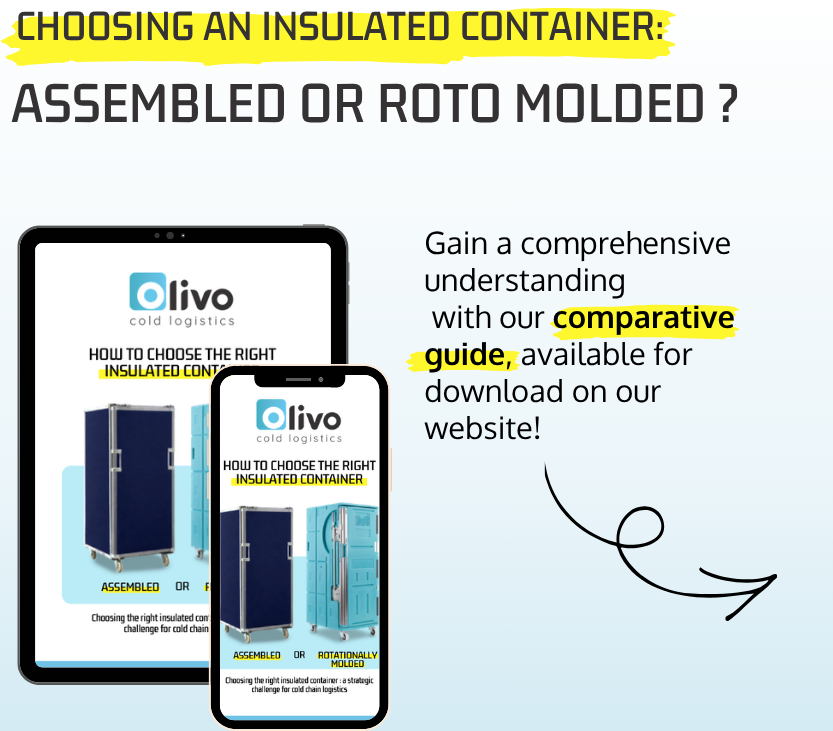
To support this reflection, a benchmark study offers a comparative analysis of insulated container technologies, based on logistics use cases and field constraints.
The assembled container is built from independent insulating panels, usually made of polyester, joined by mechanical fasteners. The seals, often silicone, are glued to the wall; the feet and casters are attached directly to the body. This modular design has its own logic: it suits certain use cases and can offer an attractive initial purchase price.
Its limitation is structural: every junction between panels creates a discontinuity. The container’s performance then depends on how well the junctions are designed and on their ability to remain watertight over time. With intensive use, problems gradually appear: micro-cracks, small openings at the joints, delamination, seals or base sections tearing away, and panels losing their flatness.
The rotomolded container is produced by rotational molding: the walls are formed as a single continuous piece of polyethylene, and the insulation is integrated without any mechanical assembly. There are no geometric breaks, no interfaces, no junctions: the structure is one piece. The seals, made of EPDM, are stapled in place; the feet and casters are mounted on a chassis that protects the integrity of the body.
It is this continuity of material that explains the differences observed across the four criteria that follow.
Ext. dim. : 800 x 1200 x 1860 mm,
Volume : 885 L,
Cold sources : eutectic plate TOP 900 et SiberSnow ®,
Logistics format : Euro-pallet 800 x 1200
View details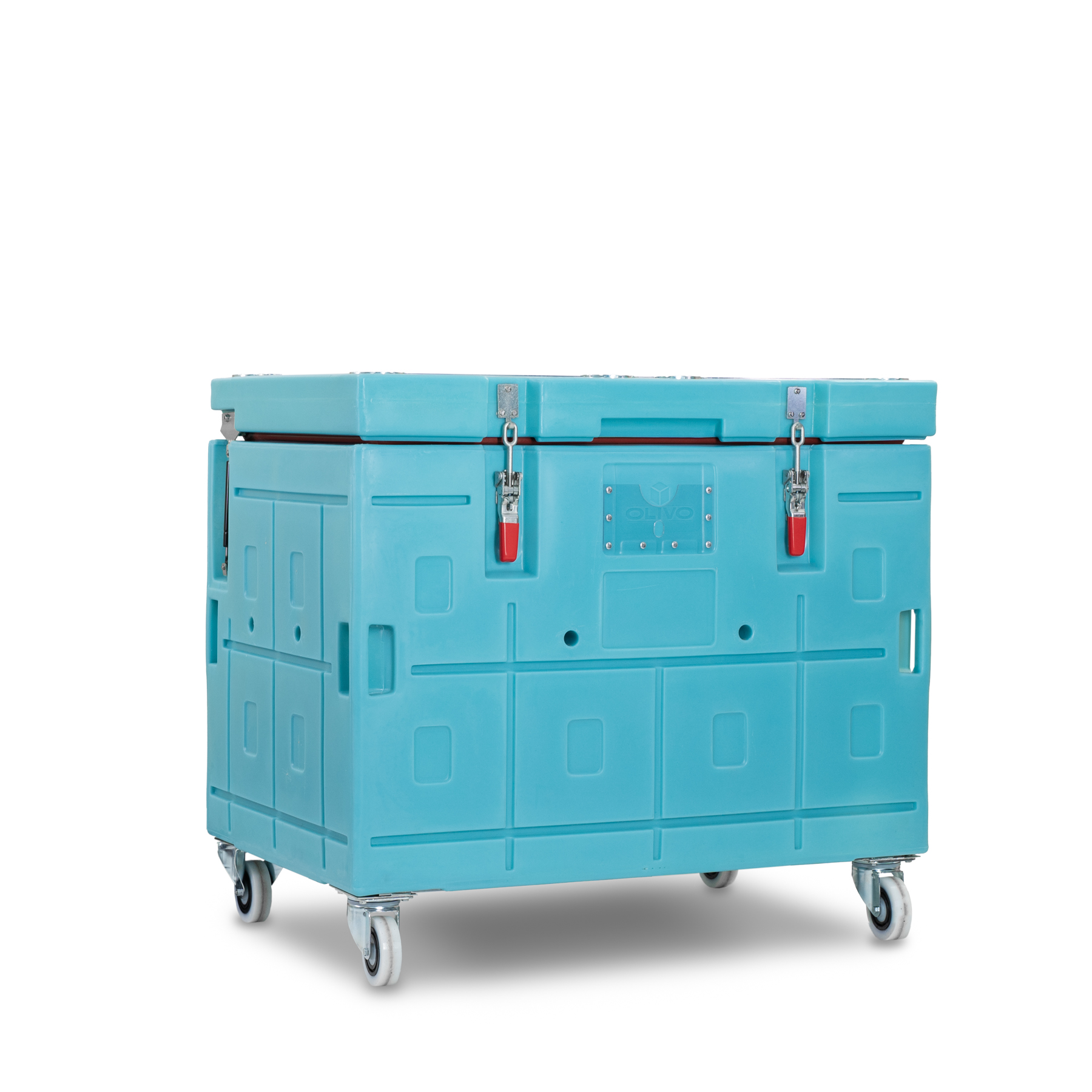
Ext. dim. : 1200 x 800 x 1085 mm,
Volume : 417 L,
Cold source : eutectic plate TOP 900,
Logistics format : Euro-pallet 800 x 1200
View details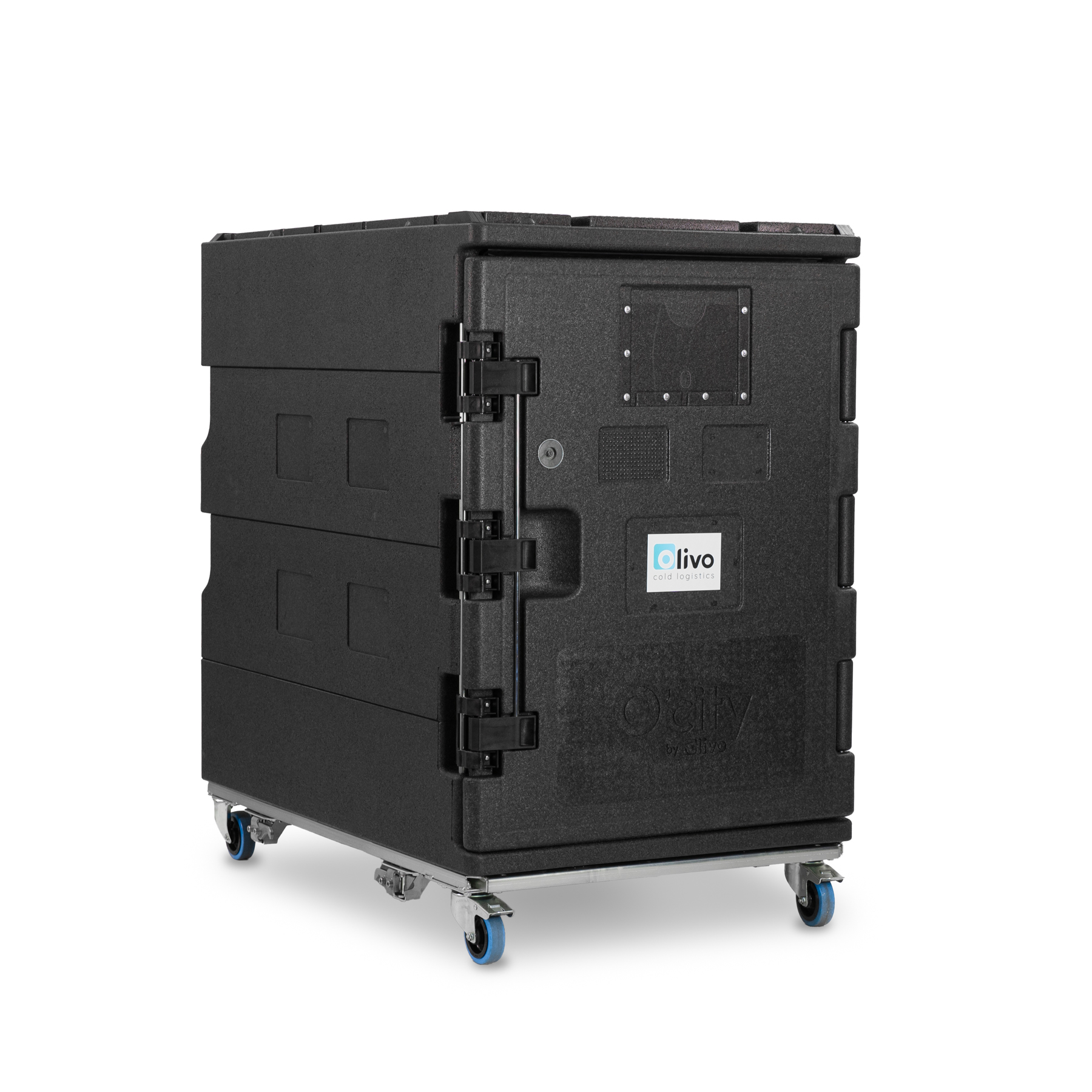
Ext. dim. : 800 x 1200 x 1270 mm,
Volume : 516 L,
Cold source : eutectic plate TOP 900,
Logistics format : Euro-pallet 800 x 1200
View details
A thermal bridge is an area where heat flow is locally higher, a breach in the insulation. On an assembled container, every junction area between panels creates a thermal discontinuity through which cold escapes. The more interfaces there are, the greater the risk of heat loss.
The one-piece structure of the rotomolded container, by contrast, provides uniform thermal resistance across all walls, limiting parasitic heat flows. Some designs also feature convection channels molded directly into the wall, which help cold air circulate around the products, a decisive advantage when temperature must be maintained over several hours of delivery rounds, for frozen as well as fresh goods.
Combined with eutectic plates, long-lasting professional cold accumulators, the rotomolded container maintains a stable controlled temperature without on-board refrigeration, in a standard truck.
In food logistics as in healthcare, hygiene is not a secondary criterion: it is a regulatory requirement and an operational risk. HACCP, IFS and BRC standards require cleaning protocols that are demonstrable and repeatable.
On an assembled container, the many interfaces, assembly seals, gaps between panels, contact areas between different materials, are all potential retention zones. Capillary action can occur; water combined with organic residues can stagnate, encouraging microbiological growth and biofilm formation. These phenomena worsen with age: seal wear, micro-play, loss of watertightness.
The rotomolded container, with no structural seals or geometric breaks, has smooth, continuous, uniform internal walls. The historically critical areas disappear; cleaning becomes faster, more repeatable and more effective. For your quality teams, this means sanitary control that holds up over time, without depending on corrective adjustments.
A professional insulated container is a logistics asset: its value is measured by the number of years it remains operational. Our clients report service lives of over six years in intensive use: “The product’s service life exceeds 6 years. The eutectic plates are also effective and robust,” says Milutin Savkovic, supply chain support at Delhaize Serbia.
Repairability makes the difference. The rotomolded container is repaired by plastic welding: the material is rebuilt by adding compatible plastic directly onto the shell. Cracks, impacts, localized punctures, wear from repeated knocks: repairs can be carried out with no theoretical limit on repetition, with few or no spare parts, and without creating any mechanical junction, and therefore without introducing a thermal bridge. The assembled container, on the other hand, is repaired by replacing panels and parts, gradually weakening the junctions.
Less breakage and controlled repairs also mean reduced downtime: your containers keep moving, and your flows stay smooth.
INFORMATIONS
Are you hesitating between several insulated container solutions ?
Talk to an Olivo expert to analyze your current use and operational issues.

Comparing two containers on purchase price alone means ignoring most of the real cost. Total cost of ownership (TCO) takes into account, over the equipment’s entire service life:
Across this full framework, the thermal stability, robustness and repairability of rotomolding translate into long-term economic performance. This is the reasoning we walk through with our clients’ procurement teams: a partnership that reduces total cost, rather than a teaser price.
The format, insulated roll, crate or box, is then chosen according to your volumes, flows and loading constraints. Our teams can help you with this sizing.
It is a container whose shell is formed as a single piece of polyethylene by rotational molding, with integrated insulation and no mechanical assembly. This one-piece structure eliminates thermal bridges and water retention areas.
In intensive use, a rotomolded container commonly exceeds six years of service, as observed by our European clients. Its repairability by material addition extends this longevity even further.
Yes. Plastic welding rebuilds the shell material, cracks, impacts, punctures, without spare parts and with no theoretical limit on repetition, while preserving the continuity of the insulation.
The purchase price varies by format and volume, but the right indicator is total cost of ownership: avoided losses, maintenance, cleaning, compliance, service life and end of life. A more durable and repairable container costs less over its full life cycle. Contact us for a study tailored to your flows.
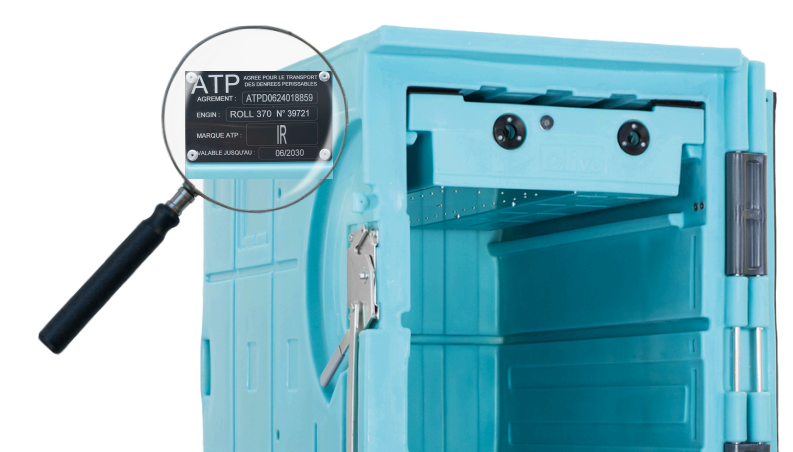
The ATP (Agreement on the Transport of Perishable Foodstuffs) governs the transport of perishable goods: our containers are designed to meet these requirements and we support their ATP renewal. The one-piece hygienic design also makes HACCP compliance easier in your protocols.
The uniform material of the rotomolded container makes it easier to recover. We take care of the recycling and end of life of your containers, as part of a circular economy approach.
For 70 years, we have put our expertise as a French manufacturer at the service of responsible, high-performance cold chain logistics. Comparing technologies is a first step; sizing the solution to your flows is another. Our teams are at your side for both.
3 September 2026 by Edina GÁLFI
2 July 2026 by Edina GÁLFI
2 June 2026 by Edina GÁLFI