

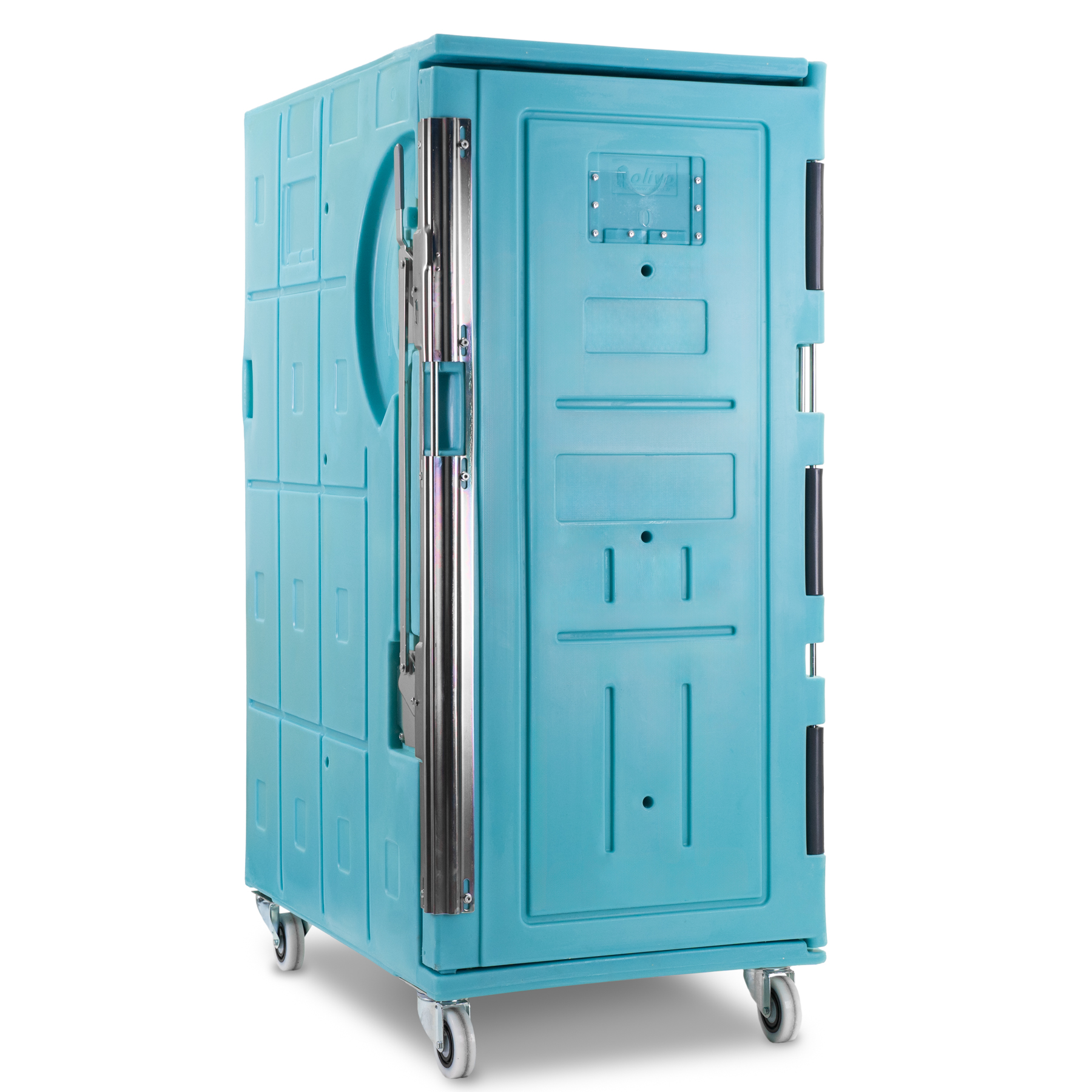

Ext. dim. : 800 x 1200 x 1860 mm,
Volume : 885 L,
Cold sources : eutectic plate TOP 900 et SiberSnow ®,
Logistics format : Euro-pallet 800 x 1200
View detailsYou might think an insulated container is simply a box that keeps things cold. And yet, anyone who has ever dealt with a broken cold chain on a loading dock at 6 a.m. knows the reality is quite different. The insulated container is the last line of defense between your temperature-sensitive goods and the hazards of the field: summer heat, delivery delays, loading times that stretch on, truck doors opening and closing dozens of times per round.
It’s a piece of equipment you forget about when it works well. But the day it fails, the consequences are measured in downgraded batches, sanitary non-compliance, sometimes product recalls. The insulated container is not a logistics accessory. It is a structural link, the one that guarantees the integrity of your products from your shipping dock to the point of delivery.


An undersized container means a cold source that runs out too quickly. A model ill-suited to your flows means handlers wasting time on every load. Equipment that doesn’t comply with ATP regulations means a legal risk hanging over every delivery round.
The problem is that these mistakes don’t show up on the day of purchase. They appear three months later, when temperature records show deviations, when the breakage rate rises, when the quality department starts asking awkward questions. In other words, this choice deserves serious consideration.
Before consulting a single catalog or requesting a single quote, there is preliminary work that many buyers overlook. Not out of incompetence, but because operational pressure pushes them to move fast. Yet it is precisely this scoping stage that determines the relevance of everything that follows.
The question seems obvious. It rarely is as obvious as it seems. Transporting yogurt between a warehouse and a supermarket is not the same as delivering plasma bags to a hospital or moving dry ice to an industrial site. Each product category imposes its own temperature-control constraints, tolerances and regulatory requirements.
Fresh products, frozen goods, biological samples, pharmaceutical preparations: the container that suits one will not necessarily suit another. And if your flows combine several product families, the complexity goes up a notch. You need to think multi-format, sometimes dual-temperature or tri-temperature, from the earliest planning stage.
Positive cold between 0 and 4°C for fresh products. Negative cold at -18°C or below for frozen goods. Controlled ambient temperature for certain pharmaceutical products. And sometimes, several ranges simultaneously in the same vehicle.
The thermal specification is not a technical detail to be settled afterwards. It determines the type of insulation required, the choice between eutectic plates and cryogenic solutions, and ultimately the right container model. Getting this wrong compromises the entire solution.
The choice of format follows directly from your distribution circuits, batch sizes and delivery frequency. A food retailer supplying supermarkets doesn’t have the same needs as a central kitchen delivering to schools, or a refrigerated carrier covering European routes.
Two hours of last-mile urban delivery? Eight hours of regional transport? Twenty-four hours for an international connection? The temperature-holding time is a decisive parameter, and it varies considerably depending on the container’s insulation quality, the cold source used and actual operating conditions.
You need to think in degraded conditions, not laboratory conditions. In the field, doors open, outside temperatures climb, stops follow one another. A container that keeps its promises in a controlled environment won’t necessarily keep them on a summer round in a city center. Better to build in a safety margin than to discover your equipment’s limits on a heatwave day.
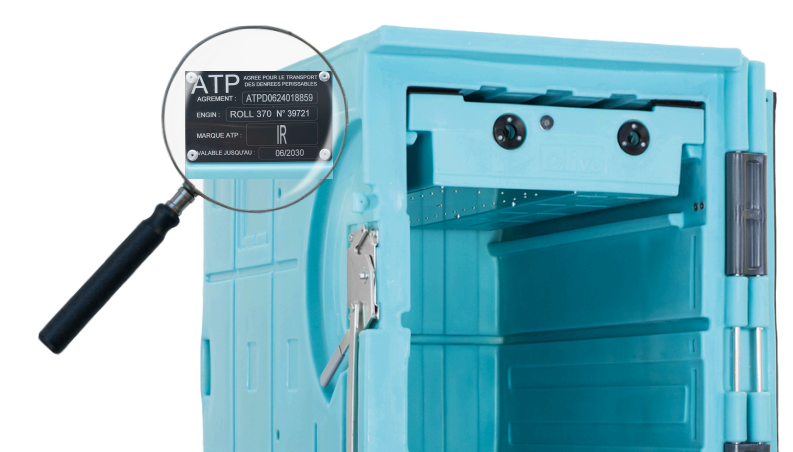
Regulation doesn’t wait. The ATP Agreement (Agreement on the International Carriage of Perishable Foodstuffs) imposes precise requirements on temperature-controlled transport equipment. HACCP standards govern food safety in the agri-food sector. GDP (Good Distribution Practices) governs pharmaceutical logistics.
Identifying your regulatory obligations before buying is not optional, it’s a prerequisite. A non-compliant container means an investment to redo, certifications to retake, audits that go badly. Better to build these requirements into your specifications from the start.
ATP certification is not just another label. It is a regulatory obligation for the international transport of perishable goods, and it requires periodic renewal. Buying an ATP-certified container is good. Making sure your supplier supports you through renewal and compliance procedures throughout the equipment’s life is better.
Documentary traceability for your containers, their certificates, renewal dates, maintenance histories, is becoming a growing challenge in a tightening regulatory environment. Think about it from the moment of purchase.
Ext. dim. : 800 x 1200 x 1860 mm,
Volume : 885 L,
Cold sources : eutectic plate TOP 900 et SiberSnow ®,
Logistics format : Euro-pallet 800 x 1200
View details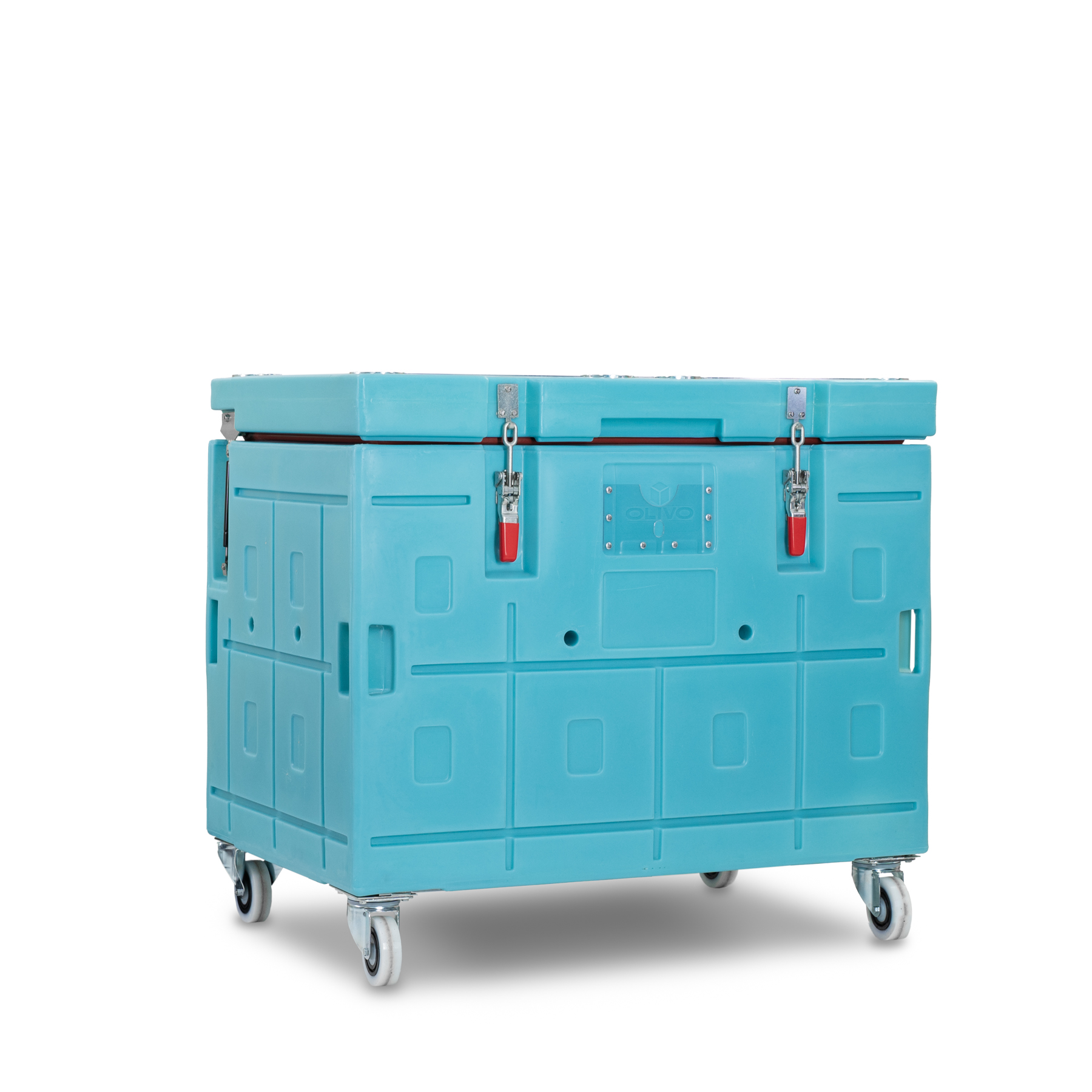
Ext. dim. : 1200 x 800 x 1085 mm,
Volume : 417 L,
Cold source : eutectic plate TOP 900,
Logistics format : Euro-pallet 800 x 1200
View details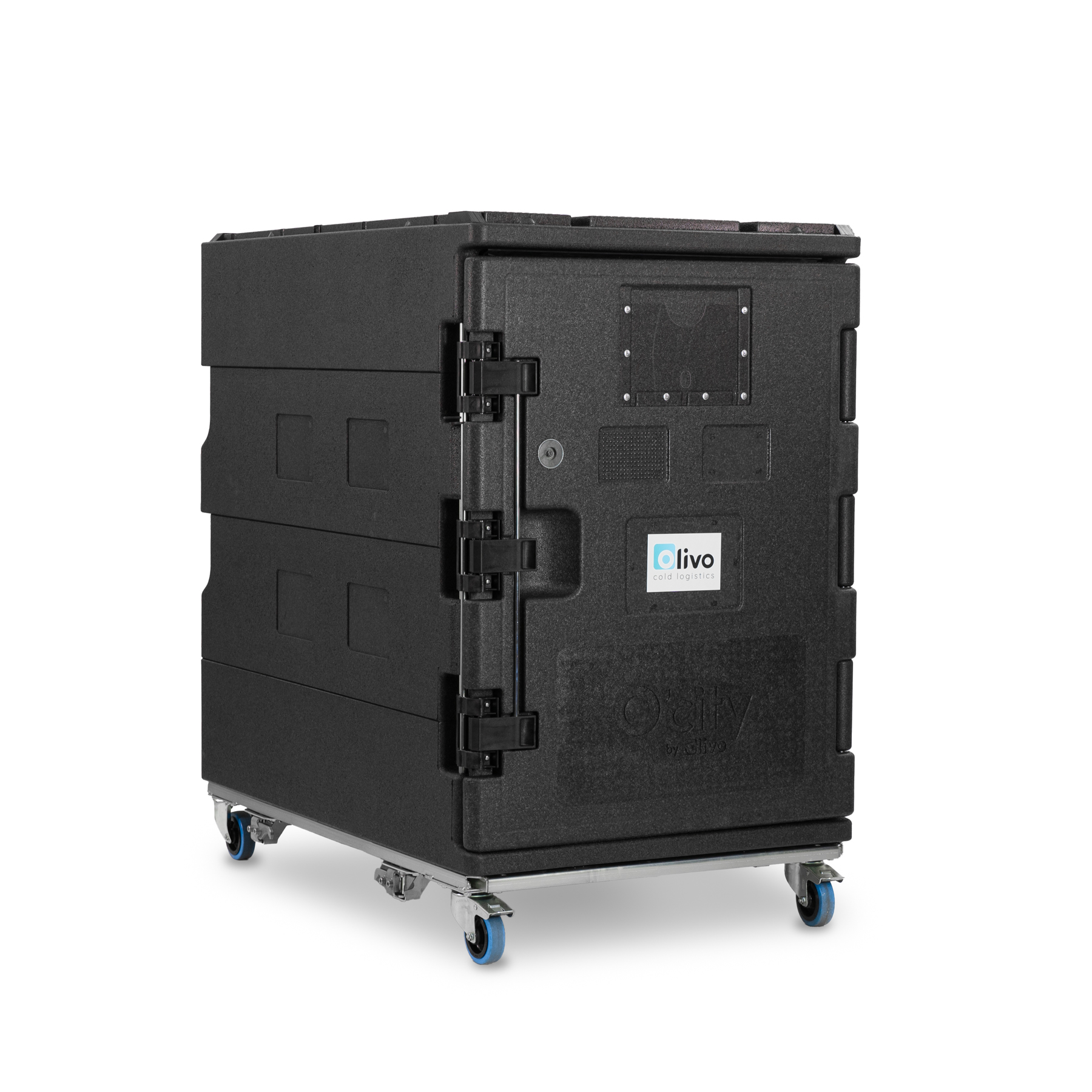
Ext. dim. : 800 x 1200 x 1270 mm,
Volume : 516 L,
Cold source : eutectic plate TOP 900,
Logistics format : Euro-pallet 800 x 1200
View details
Once your needs are clearly defined, you still have to translate that framework into concrete selection criteria. This is where the subject becomes truly technical, and it is also where the differences between the solutions on the market become apparent.
Not all insulated containers are equal. Insulation performance is measured by the K coefficient, which expresses the heat loss of the envelope. The lower the coefficient, the better the insulation. But beware of data sheets showing performance measured under ideal conditions: what matters is the container’s actual behavior in operation, with door openings, load variations and fluctuating weather conditions.
The container alone does nothing. It is the container/cold-source pairing that delivers performance. Two main families stand out.
Eutectic plates are rechargeable cold accumulators, robust, proven over decades in food distribution. They offer predictable autonomy, silent operation with no emissions, and remarkable longevity when properly maintained.
Cryogenic solutions, such as the SIBER SYSTEM®, follow a different logic: CO2 snow production by expansion of liquid CO2, dual-temperature refrigeration, an integrated cold refill station. These are more advanced technologies, suited to specific needs for high cooling power or thermal flexibility.
The choice between these two families depends on your operational constraints, your existing infrastructure and your decarbonization strategy. It’s not a choice you make alone at your desk, it’s a subject to work through with an expert who knows both worlds.
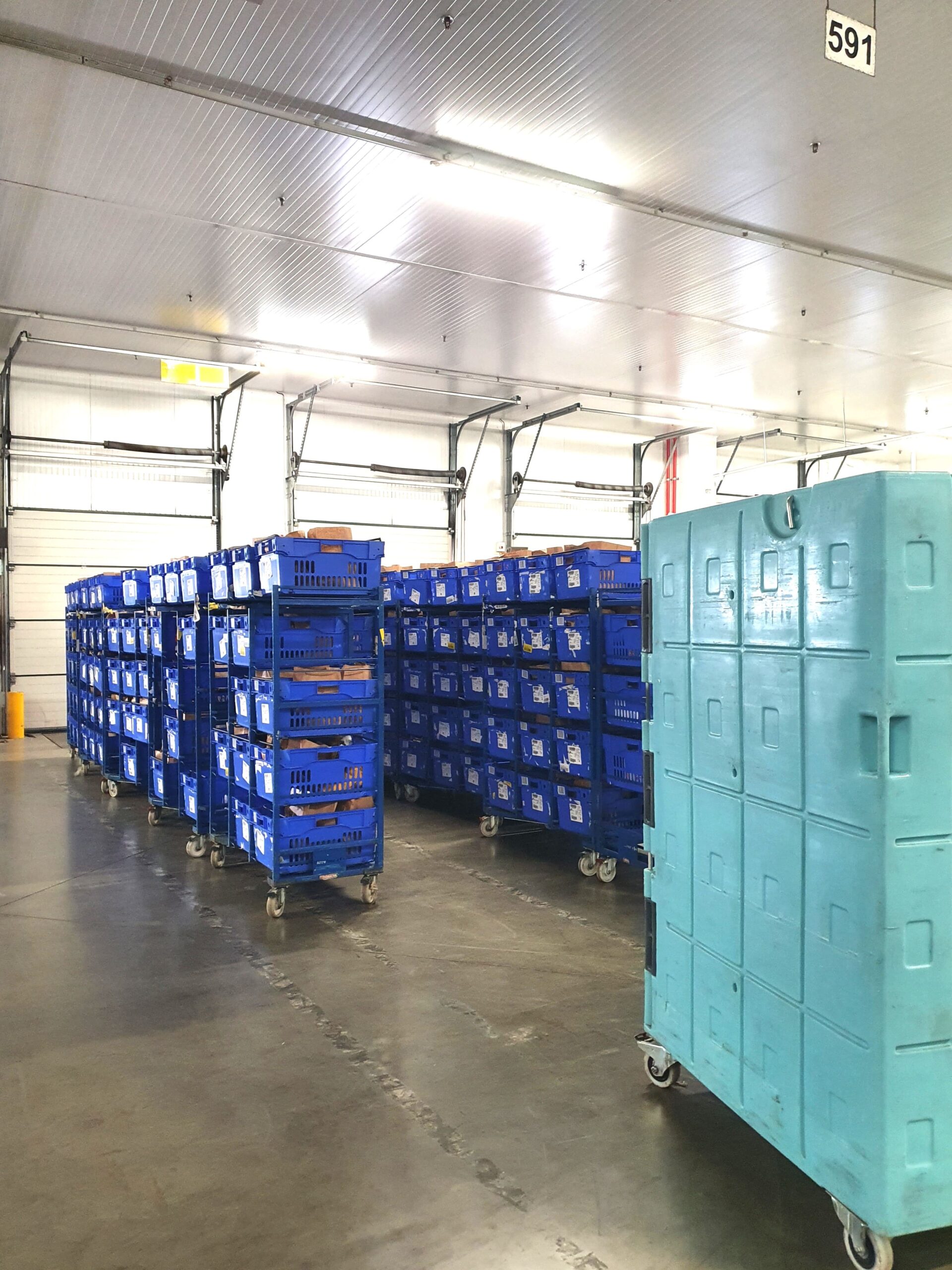
In real-world operation, an insulated container endures hundreds of loading and unloading cycles per year. It is handled by forklift operators, pushed across docks, stacked in trucks, exposed to the weather, cleaned with high-pressure jets. Robustness is not a marketing argument — it is a condition for the equipment’s economic survival.
When a client like Delhaize in Serbia confirms that its containers exceed six years of service life in intensive use, with eutectic plates still effective and robust, that is data that carries weight in the evaluation. Durability is proven in the field, not in a sales brochure.
It’s not always considered early enough, and that’s a shame. A container can be technically perfect and yet unsuited to your operations if its dimensions don’t fit in your trucks, if its casters aren’t right for your dock floors, if its empty weight makes handling difficult for your teams.
Compatibility with your existing fleet, vehicles and storage infrastructure alike, must be checked upstream. It’s a pragmatic, operational criterion that prevents many disappointments at deployment time.
INFORMATIONS
Are you hesitating between several insulated container solutions ?
Talk to an Olivo expert to analyze your current use and operational issues.

A manufacturer that designs, builds and assembles its containers in its own workshops controls the entire value chain. It knows every component, every design choice, every technical trade-off that was made. This mastery translates into customization capability.
Need a specific format for your trucks? A thermal configuration adapted to your delivery circuits? Custom integration of eutectic plates into a particular geometry? These are conversations that only make sense with a manufacturer.
French manufacturing: the guarantee of industrial mastery and proven expertise
Choosing a French manufacturer means, above all, relying on true industrial mastery: design, production and quality control are carried out on a single site, with no intermediaries or distant subcontracting. Every step of the process is controlled from end to end, from material selection to finishing.
French manufacturing is not a patriotic argument. It is the assurance of expertise built and refined over more than 70 years, passed down through generations of specialized teams. This expertise translates concretely into the quality of your equipment: containers designed to last, compliant with ATP requirements, and built by professionals who thoroughly understand the constraints of cold logistics and the realities of your business.
The most common mistake when buying insulated containers is thinking in terms of unit purchase price. The price on the quote represents only a fraction of the real cost. What matters is the total cost of ownership over the equipment’s entire service life.
A container that is cheaper to buy but loses insulation performance after two years, requires frequent repairs, or has to be replaced after four years, costs more than premium equipment amortized over twelve years. It’s common sense, but it often runs up against annual budget logic that favors the lowest bidder.
If you work in procurement, you know it: the TCO (Total Cost of Ownership) approach is the only one that allows an honest comparison of seemingly comparable offers. And it includes cost items that the purchase price doesn’t show.
An insulated container lives, wears, takes knocks. Seals deteriorate, hinges tire, insulation can be compromised by an impact. Your supplier’s ability to provide preventive and corrective maintenance for your equipment is a selection criterion at least as important as initial performance.
As for ATP renewal, it is a mandatory step with a regulatory timetable. A partner that includes this support in its offer spares you a significant administrative and logistical burden. A mere vendor will leave you to figure it out yourself.
What happens to an insulated container at the end of its life? The question is being asked more and more, and not only by CSR departments. End-of-life management, material recycling, component recovery: it’s an obvious environmental issue, but also a growing compliance issue.
A manufacturer committed to a circular economy approach takes back its equipment at end of life, organizes its recycling, and provides you with the traceability you need for your CSR reports. That’s a service with real value — one that distinguishes a true partner from a purely transactional supplier.
Do the math. If your container lasts three years, you buy it twice over a six-year period. If your container lasts twelve years or more, the initial investment is diluted, the annual cost drops, and you gain operational stability.
This is confirmed by the experience of clients like Delhaize, who operate containers well beyond the six-year mark with no significant performance degradation. It’s not a theoretical argument: it’s a field-proven, measurable, verifiable reality.
Buying an insulated container, when done right, is a structured process. Here are the steps that turn a need into a reliable operational solution.
Map your distribution circuits, identify critical points (loading times, distances, number of stops, local climate conditions), measure your actual volumes. This audit is the foundation of everything else. Without it, you’re buying blind.
Target temperature, vehicle used, distance to cover, holding time, format, volume, handling constraints, regulatory requirements, compatibility with your existing fleet. Put everything on paper. Precise specifications are the best way to get relevant answers from your contacts. They’re also the best filter for distinguishing serious partners from catalog sellers.
Look for a manufacturer, not simply a supplier. Someone who masters design, production, cold sources, ATP regulations, maintenance and end of life. Someone who will ask you questions about your flows before offering you a product. The quality of the technical dialogue during the consultation phase is an excellent indicator of the quality of the relationship to come.
Never deploy a full fleet without testing the solution on a pilot circuit. Measure thermal performance in real operation, gather feedback from your operators, check compatibility with your infrastructure. This validation phase avoids costly deployment errors and allows you to fine-tune the solution before scaling up.
Once the solution is validated, deployment goes hand in hand with a preventive maintenance plan: checking seals, verifying insulation, servicing casters and hinges, monitoring eutectic plates, anticipating ATP renewals. It is this long-term follow-up that guarantees the return on investment.
Ultimately, the real question is not just how to buy an insulated container. It’s who to build a cold chain with that is reliable, efficient and built to last.
A supplier sells you a product. A partner understands your flows, anticipates your changes, supports you with regulatory compliance, optimizes your loads, and helps you decarbonize your cold chain logistics. The difference doesn’t always show on the quote. It shows in the field, year after year.
Since 1956, Olivo has supported players in food distribution, logistics, healthcare and cryogenics in deploying insulated solutions designed to last. As France’s leading manufacturer of insulated containers, we design, build and maintain our equipment with one constant goal: putting our industrial expertise and capacity for innovation at the service of responsible, high-performance cold chain logistics.
Because a conscious, responsible cold chain has never been more vital, the choice of your insulated container deserves better than a simple price comparison. It deserves a real dialogue, a manufacturer’s expertise, and a long-term commitment. We’re here to talk about it.
3 September 2026 by Edina GÁLFI
2 July 2026 by Edina GÁLFI
2 June 2026 by Edina GÁLFI