


How do you get the best value for money in a professional insulated container ?
1 October 2026 by Edina GÁLFI
29 October 2026 by Edina GÁLFI
Central kitchens, school caterers, hospitals, care homes, company restaurants: everyone in communal catering (Gemeinschaftsverpflegung) faces the same question when equipping or renewing their fleet. Which insulated container is best ? The honest answer from a manufacturer who has been designing them since 1956 fits in one sentence: there is no best container in absolute terms, but there is a best choice for each operation. Equipment that excels on a short urban round may fall short on a 50-kilometre delivery with waiting time on site, and a fleet sized for hot delivery will not suit a cook and chill system. This article gives you the method: the criteria that compare equipment objectively, the right format for each distribution model used in Germany, and how to put suppliers to the test before you commit.
In communal catering, the insulated container is not an accessory: it is the link that keeps meals within safe temperatures between production and service. And in Germany, the choice of catering system (Verpflegungssystem) defines what the container must achieve.
In hot delivery (Warmverpflegung), still the most widespread model in German school catering, meals must be held at a safe hot temperature from the moment cooking ends until the last diner is served, with a maximum hot-holding time of three hours recommended by the federal risk assessment body (BfR) and the DGE quality standards. That three-hour clock includes the journey: the container’s job is to protect both the temperature and the timing. Since 2020 the BfR recommendation sets the minimum hot-holding temperature at 60 °C, while 65 °C remains the benchmark written into most specifications and DIN 10508, the German standard for food temperatures.
In cook and chill and cook and freeze systems, widely used by contract caterers supplying schools, care homes and hospitals, meals travel chilled (product-specific limits, typically between 4 and 7 °C for perishables) or frozen at -18 °C, and are regenerated on site to a safe core temperature, commonly specified at 72 °C. Here the container must hold a low temperature reliably for hours, including the wait before regeneration.
Two operations running different systems, route lengths and site types will therefore reach different conclusions from the same catalogue. The “best” container is defined against a reference framework: yours.
Once your framework is set, five criteria let you compare on facts rather than sales arguments.
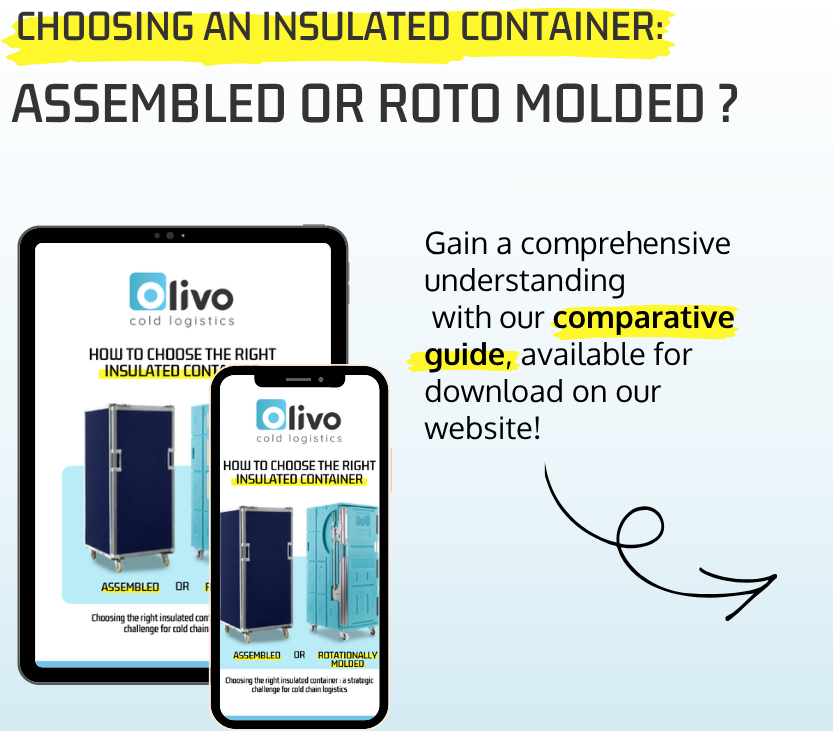
To support this reflection, a benchmark study offers a comparative analysis of insulated container technologies, based on logistics use cases and field constraints.

The format follows from volumes, distances and delivery conditions. Three configurations cover most of communal catering.
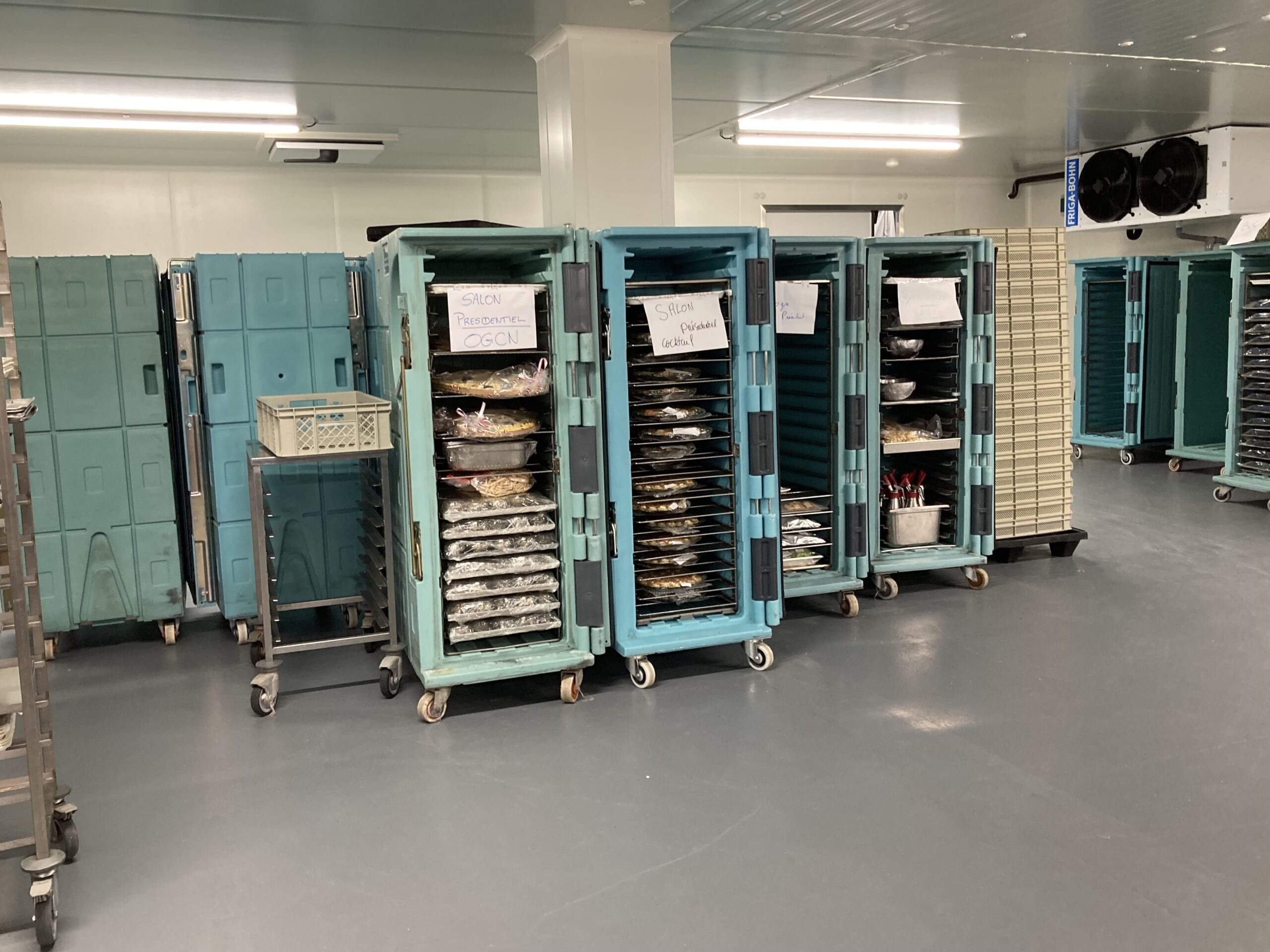
For daily rounds to schools, care homes or company restaurants, with substantial volumes per site and stops that must stay short, the roll container leads: an insulated ROLL loads gastronorm pans on several levels, is organised site by site inside the vehicle and rolls from dock to servery with no carrying. On hot delivery rounds, shorter stops also protect the three-hour window.
Small sites, special and allergen-safe diets to segregate, serveries without wheeled access, smaller vehicles: modularity comes first. A compact, stackable insulated BAC lets you build each round container by container and keep sensitive meals separate, labelled by site or by diet.
A central kitchen serving a wide catchment, or meals consolidated towards a hub before local distribution: these routes demand extended thermal autonomy. A rigid insulated BOX with reinforced insulation is built for long-duration transport and consolidated loads.
In most operations the “best” choice is in fact a mixed fleet, sized site by site, in which every format shares the same cold sources and the same cleaning protocols.
An insulated container produces neither cold nor heat: it slows heat exchange. Real performance comes from the complete system it forms with its cold source and the organisation around it.
For chilled and frozen transport, eutectic plates release the cold accumulated during recharging, consuming nothing in transit. Two parameters deserve care: the plate’s freezing point, matched to the product (a frozen-food formulation can freeze chilled dishes), and the number of plate sets, so one set recharges while another is on the road. For hot delivery, insulation is complemented by a heat source such as a heating plate, an item available from specialist equipment suppliers.
Operational discipline does the rest: load in reverse delivery order, keep door openings short, record temperatures at every critical point in line with your HACCP-based procedures, and check seals regularly. The best container badly used will lose to a good container well integrated into its processes.
INFORMATIONS
Are you hesitating between several insulated container solutions ?
Talk to an Olivo expert to analyze your current use and operational issues.

To separate offers that look alike on paper, three practices work. Ask for thermal test reports and compare the curves over the duration of your actual route, waiting time included, not a theoretical figure. Calculate total cost of ownership over at least six years (purchase price, maintenance, parts, ATP renewal, end-of-life value) rather than unit price. And trial in real conditions: one week on one of your rounds, with your staff and your gastronorm pans, reveals what no data sheet shows, from manoeuvrability in your corridors to cleaning time in your serveries. A manufacturer confident in its product will accept the exercise readily; references from operations comparable to yours complete the validation.
The roll container is the reference for multi-site rounds: direct gastronorm loading, organisation by site inside the vehicle, fast unloading with no carrying. It is complemented by insulated boxes in small formats for minor sites and diets that must travel separately, and by a large rigid box for long legs. Exact sizing depends on volumes per site and route duration, and on your catering system.
In hot delivery, the recommended maximum of three hours between the end of cooking and the last serving includes transport and waiting time. The container must therefore hold the hot-holding temperature (60 °C minimum per current BfR recommendation, 65 °C in most specifications) across the whole round, and route planning must keep the last site within the window. Where rounds cannot fit, cook and chill with on-site regeneration is the usual alternative, and the container requirement shifts to reliable chilled holding.
With measured data: test reports, temperature-rise curves, ATP certification where applicable. The comparison only makes sense over your real route duration, waiting time included, and with the cold source intended for use. Failing comparable data, ask for a trial in real conditions: it is the referee.
More than six years of intensive use for industrial-grade equipment, as long-standing users confirm. Maintaining the wear parts (seals, castors, catches) extends that lifespan, and periodic ATP renewal validates that performance remains compliant over time.
At the end of the analysis, the “best insulated container for communal catering” is simply defined: the one whose performance is proven on your actual routes, that your staff handle without strain or risk, that fits your pans and your sites, and that a partner maintains with you for more than six years. Since 1956, Olivo has designed and manufactured professional insulated containers in France for communal catering across Europe, supporting each operation from flow analysis to end-of-life recycling. Want to put figures on your next investment? Contact our teams: we study your distribution model with you and recommend exactly the equipment you need.
Do you need more information or would you like to talk to our teams about your project ?

ZA Charles Chana
1 boulevard des Mineurs – CS 50019
42230 Roche-la-Molière

Tel : +33 (0)4 77 90 68 63
1 October 2026 by Edina GÁLFI
29 October 2026 by Edina GÁLFI
17 September 2026 by Edina GÁLFI


