

How do you get the best value for money in a professional insulated container ?
1 October 2026 by Edina GÁLFI
15 October 2026 by Edina GÁLFI

Delivering meals at the correct temperature is not simply a quality objective. It is a legal obligation, a food safety imperative, and increasingly a measure of operational efficiency. Whether you manage a contract catering fleet supplying hospital wards, a central kitchen distributing to school sites, or a dark kitchen fulfilling last-mile orders across a city centre, the container you choose determines how reliably your cold chain performs from dispatch to service point.
Yet the market offers dozens of formats, materials and capacities. Choosing the wrong one means temperature breaches, wasted food, and compliance risk. This guide sets out the practical criteria that matter most for UK meal delivery operations, then maps them to proven isothermal solutions.
Refrigerated vehicles maintain ambient conditions during transit, but the moment a roll cage or tray leaves the vehicle, temperature control passes entirely to the container. In multi-drop rounds, that exposure window can stretch to fifteen or twenty minutes per stop. In liaison froide (cook-chill) operations delivering to satellite kitchens, containers may spend hours in corridors, goods lifts or holding areas before food reaches regeneration ovens.
UK food safety law, underpinned by Regulation (EC) 852/2004 retained in domestic legislation, requires chilled foods to remain below 8 °C, though best practice targets 5 °C or lower. Hot-held meals must stay above 63 °C. Any container that cannot guarantee these thresholds across the full journey, including dwell time at the delivery point, is a compliance liability.
Beyond regulation, there is a commercial dimension. Temperature excursions degrade texture, flavour and shelf life. For caterers operating on tight margins, spoilage translates directly into cost. The container is not packaging: it is an active element of your quality system.
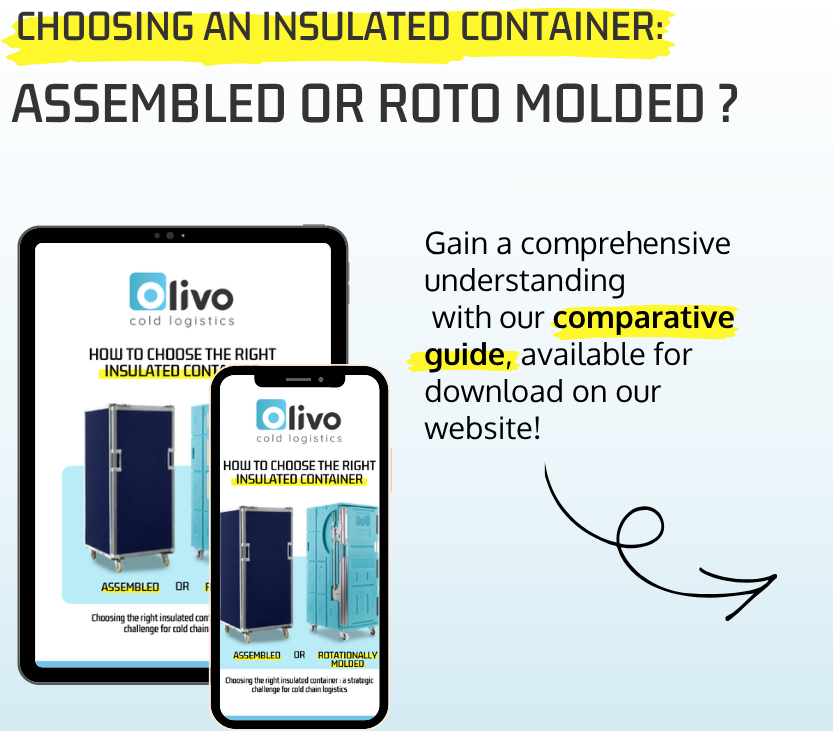
To support this reflection, a benchmark study offers a comparative analysis of insulated container technologies, based on logistics use cases and field constraints.

The core question is simple: how long does the container maintain the required temperature without an external energy source? This thermal autonomy depends on insulation thickness, panel construction, seal integrity, and the cold (or heat) source used. A well-designed isothermal container paired with eutectic plates can hold temperature for several hours, far exceeding the capability of insulated bags or lightweight polystyrene boxes.
Eutectic plates are reusable cold accumulators charged in a freezer or blast chiller overnight. They release energy at a controlled rate, maintaining a stable interior temperature. Unlike single-use gel packs, they offer consistent performance across thousands of cycles, which brings long-term cost benefits and reduces waste.
Meal delivery rarely involves a single container format. A central kitchen dispatching gastronorm trays needs a solution that integrates with existing racking. A catering company loading a van with individual client orders may prioritise stackable boxes. A large-scale operation moving hundreds of covers per round will favour wheeled roll containers that speed up loading and reduce manual handling risk.
Consider the full handling chain: kitchen loading bay, vehicle, delivery entrance (which may involve steps, narrow corridors, or a goods lift), and the receiving area. The container must be practical at every stage.
Food contact surfaces must withstand daily cleaning with professional detergents. Smooth internal walls, rounded corners, and food-safe materials are non-negotiable. Containers with removable components simplify deep cleaning and HACCP audits.
A cheap container replaced every eighteen months is more expensive than a robust one lasting six years or more. In professional meal delivery, containers endure daily loading cycles, vehicle vibration, stacking pressure, and frequent washing. The chassis, hinges, seals, and insulation panels must all be engineered for this sustained use. Evaluating total cost of ownership rather than unit purchase price changes the procurement equation significantly.
For operations transporting perishable goods over longer distances or across borders, ATP certification (the Agreement on the Transport of Perishables, an international treaty governing insulated and refrigerated transport equipment) may apply. Even where ATP is not strictly required, choosing ATP-certified containers demonstrates a measurable standard of thermal performance that reassures auditors, clients and environmental health officers.
To support this reflection, a benchmark study offers a comparative analysis of insulated container technologies, based on logistics use cases and field constraints.
Not every meal delivery operation has the same constraints. The right format depends on volume, vehicle type, delivery context, and the nature of the food being transported.
The insulated ROLL is a wheeled container designed for rapid loading and unloading. Its integrated castors allow one operator to move large quantities of meals from kitchen to vehicle to delivery point without transferring contents between receptacles. This reduces handling time, limits temperature exposure, and cuts labour cost per drop.
ROLL containers suit contract caterers serving hospitals, schools, or corporate sites where dozens or hundreds of covers arrive simultaneously. Combined with eutectic plates, they maintain chilled or frozen temperatures throughout extended delivery windows.
The insulated BAC is a mid-size container optimised for stacking and vehicle load planning. Its compact footprint suits operations where multiple temperature zones coexist in a single vehicle: chilled meals alongside ambient desserts or frozen components.
For caterers managing diverse menus with varying thermal requirements, BAC containers offer the modularity to organise each delivery by client, by course, or by temperature tier, without cross-contamination risk.
The insulated BOX is a rigid caisson built for maximum thermal autonomy. It is the format of choice when meals travel long distances, when ambient temperatures are high, or when the delivery chain includes unpredictable waiting periods.
BOX containers also serve operations requiring strict temperature segregation for regulatory or quality reasons, such as pharmaceutical-grade meal services in healthcare settings.
INFORMATIONS
Are you hesitating between several insulated container solutions ?
Talk to an Olivo expert to analyze your current use and operational issues.

A container without an appropriate cold source is simply an insulated shell. The combination of container and cold source defines real-world performance.
Olivo’s eutectic plates are engineered to match each container format, delivering targeted temperature maintenance (chilled, frozen, or bi-temperature) without any electrical connection during transit. They charge overnight in standard cold rooms, releasing energy progressively throughout the delivery round. Their robustness means a service life measured in years, not months.
For operations requiring rapid or on-demand cold generation, SIBER SYSTEM® cryogenic solutions offer an alternative: CO2-based refrigeration that can produce bi-temperature conditions in a standard vehicle, eliminating the need for dedicated refrigerated fleets.
Purchasing containers is a procurement event. Building a reliable cold chain for meal delivery is an ongoing operational commitment. The distinction matters.
Olivo has manufactured isothermal containers in France since 1956. That depth of experience, now spanning 70 years, translates into tangible advantages for UK food service operators:
This is the difference between a transactional supplier and a genuine cold chain partner: ongoing support, technical expertise, and a shared commitment to responsible, efficient food logistics.
Thermal autonomy varies by container model, insulation specification, and the cold source used. With Olivo eutectic plates, professional containers can maintain chilled temperatures (below 5 °C) for several hours, comfortably covering multi-drop delivery rounds. Exact performance depends on ambient conditions, load density, and door-opening frequency.
ATP (the Agreement on the Transport of Perishables) applies to international transport of perishable foodstuffs and to certain domestic operations. Even where certification is not legally mandatory, ATP-rated containers provide a verified thermal performance benchmark that strengthens your HACCP documentation and due diligence position.
Yes. Using separate insulated containers with dedicated thermal sources (eutectic plates for chilled items, insulated hot boxes for liaison chaude), you can safely segregate temperature zones within one vehicle. Olivo’s range supports multi-temperature configurations in standard, non-refrigerated vehicles.
A eutectic plate is a professional cold accumulator containing a phase-change solution calibrated to release cold at a specific temperature. Unlike disposable gel packs, eutectic plates are rechargeable, deliver consistent thermal output across thousands of cycles, and are designed for the demands of daily commercial use.
Every meal delivery operation has its own constraints: volume, distance, menu complexity, vehicle fleet, regulatory environment, sustainability targets. The right isothermal container is the one that addresses all of these factors together, not just the most obvious one.
Olivo’s technical team works with food service professionals across Europe to specify the container format, cold source, and service package that fits each operation precisely. If you are evaluating your meal delivery cold chain, whether upgrading existing equipment or designing a new distribution model, contact Olivo for a tailored consultation. We are here to help you build a cold chain that is reliable, compliant, and built to last.
Do you need more information or would you like to talk to our teams about your project ?

ZA Charles Chana
1 boulevard des Mineurs – CS 50019
42230 Roche-la-Molière

Tel : +33 (0)4 77 90 68 63
1 October 2026 by Edina GÁLFI
17 September 2026 by Edina GÁLFI
3 September 2026 by Edina GÁLFI